When severe weather or a power outage disrupts normal communication, a dependable emergency radio can provide critical alerts, lighting, and backup charging in one compact device.
We selected 10 waterproof emergency radios with practical combinations of NOAA access, hand-crank and solar power, battery capacity, durability, and everyday portability.
Best 10 Waterproof Emergency Radios Picks for 2026
Best All-Around Pick

- NOAA auto-scan with AM/FM and Bluetooth
- 5,000mAh battery plus crank and solar charging
- IPX5 waterproof, flashlight, USB charging, and SOS alarm
Best For: Compact storm kits, camping, and everyday emergency preparedness
Classic Preparedness Pick

- NOAA weather scan and alert capability
- Solar power plus six included AA batteries
- Flashlight, SOS signal, and ultrasonic dog whistle
Best For: Home emergency kits and basic outdoor preparedness
High-Capacity Pick
Mesqool 12000mAh Weather Radio

- 12,000mAh battery for longer emergency use
- NOAA, FM, and AM reception with extended antenna
- Large solar panel, hand crank, lights, and phone charging
Best For: Extended outages, household kits, and off-grid camping
Survival Kit Bundle Pick
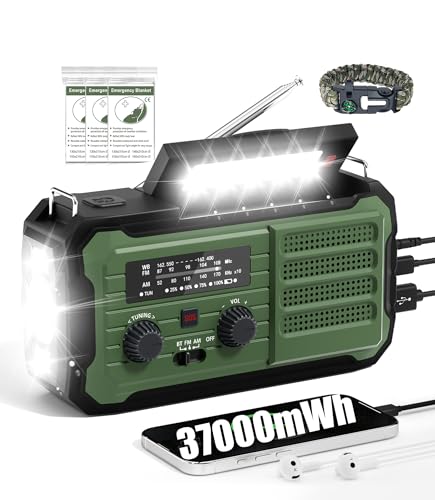
- 37,000mWh battery with solar and hand-crank charging
- NOAA auto-scan, flashlight, headphone jack, and SOS alarm
- Includes thermal blanket and survival paracord bracelet
Best For: Camping, bug-out bags, and bundled emergency preparedness
Best Multi-Source Alert Coverage

- Automatic NOAA alerts with standby scanning
- Six charging options and phone charging
- Flashlight, reading lamp, SOS siren, and LCD
Best For: Home kits and campers needing flexible charging and automatic alerts
Best Waterproof Power Backup
Roxicosly 12000mAh Weather Radio

- IPX6 waterproof rating for outdoor conditions
- 12000mAh battery with phone-charging capability
- Large solar panel, hand crank, dual lights, and NOAA alerts
Best For: Storm preparedness, blackouts, and wet outdoor environments
Best Compact Value Pick
FosPower A1 Solar Hand Crank Radio

- Lightweight 310-gram design with NOAA, AM, and FM
- 7400mWh power bank for small-device charging
- Solar, hand-crank, and AAA-battery power options
Best For: Lightweight go-bags and basic power-outage preparedness
Best with Extra Features

- 12,000mAh battery with phone-charging support
- Solar, hand-crank, USB-C, and AAA power options
- IPX6 water-resistant with flashlight and 120dB SOS alarm
Best For: Extended home, vehicle, RV, and camping preparedness
Best Battery-Life Pick
QAUYYW 20,000mAh Emergency Radio

- Large 20,000mAh rechargeable battery
- IPX6 waterproof design for home and outdoor use
- Solar, hand-crank, and USB-C charging
Best For: Extended runtime and emergency phone charging
Best Compact Bluetooth Pick

- Lightweight 263-gram portable design
- Bluetooth 5.0 plus NOAA/AM/FM reception
- Solar, hand-crank, and USB-C charging with SOS alarm
Best For: Camping, hiking, and lightweight emergency kits
Best All-Around Pick – KAYINOW NOAA Emergency Radio
If you want waterproof emergency radios with useful everyday features, the KAYINOW combines NOAA weather scanning, AM/FM reception, Bluetooth audio, and several backup power options in a compact design. Its IPX5 rating, rechargeable battery, hand crank, and solar panel make it practical for storm kits, camping, and power outages.
Best For: Buyers who want a compact emergency radio that also works as a Bluetooth speaker and phone charger.
Pros:
- Automatically scans seven NOAA weather channels and locks onto the strongest signal.
- Offers a 5,000mAh battery, hand crank, solar charging, and USB-C input.
- Includes a 90-lumen flashlight, reading lamp, USB device charging, and 95dB SOS alarm.
- IPX5 waterproof and drop-proof construction in a lightweight 0.96-pound body.
Cons:
- The TF card is not included.
- Its battery capacity is lower than some larger emergency-radio options.
Choose this model when you value portability and versatility more than maximum battery capacity. Bluetooth playback and dual-mode lighting give it extra usefulness beyond emergency broadcasts.
Classic Preparedness Pick – Midland ER310 Emergency Radio
The Midland ER310 is a straightforward emergency radio for shoppers who prioritize established preparedness features over extras. It includes NOAA weather scan and alert capability, AM/FM reception, multiple power sources, a flashlight, SOS signaling, and an ultrasonic dog whistle.
Best For: Preparedness-focused buyers who want a simple radio with core alerting and signaling tools.
Pros:
- Includes NOAA weather scan and alert functionality.
- Provides multiple power sources, including solar power and six included AA batteries.
- Built-in flashlight, SOS emergency signaling, and ultrasonic dog whistle add utility.
- USB connectivity can support smartphone or tablet use.
Cons:
- The supplied specifications list it as not water resistant.
- It does not offer the dedicated waterproofing found on some competing models.
- The feature set is more basic than Bluetooth-equipped alternatives.
This is a sensible choice for a home emergency kit or outdoor preparedness setup, but it is not the right fit if waterproofing is a firm requirement. Store it in a protective dry bag for wet-weather use.
High-Capacity Pick – Mesqool 12000mAh Weather Radio
For buyers seeking waterproof emergency radios with substantial backup power, the Mesqool pairs a stated 12,000mAh lithium battery with NOAA, FM, and AM reception. Its large solar panel, hand crank, flashlight, reading lamp, and phone-charging capability are geared toward extended outages and off-grid use.
Best For: Households and campers who want extended battery capacity and easy-to-use lighting controls.
Pros:
- Large 12,000mAh battery supports radio, lighting, and emergency phone charging.
- Uses solar, hand crank, USB-C input, and three AAA batteries as power options.
- Receives NOAA, FM, and AM broadcasts with a high-sensitivity signal design and extended antenna.
- Includes a focused flashlight, soft reading lamp, SOS alarm, and large controls.
Cons:
- The supplied notes do not specify a water-resistance rating.
- Its 6.8-by-2.9-by-4.7-inch body is less compact than smaller models.
- The battery should be fully charged before first use.
The Mesqool stands out for capacity and operation flexibility. If you need a radio for wet conditions, verify the current water-resistance specifications before buying, since the supplied listing information does not confirm waterproofing.
Survival Kit Bundle Pick – 10000mAh NOAA Emergency Radio
This 10,000mAh emergency radio is aimed at buyers building a broader survival kit. Along with NOAA auto-scan, AM/FM reception, hand-crank and solar charging, it includes a flashlight, headphone jack, SOS alarm, thermal blanket, and multi-tool paracord bracelet.
Best For: Outdoor users who want an emergency radio bundled with basic signaling, warmth, and utility accessories.
Pros:
- Provides a stated 37,000mWh rechargeable battery with hand-crank and solar charging.
- Automatically scans seven NOAA weather channels, including while in standby mode.
- Includes a flashlight, headphone jack, USB device charging, and SOS alarm with flashing red light.
- Comes with a thermal blanket and paracord bracelet containing survival tools.
Cons:
- The supplied notes do not provide a specific water-resistance rating for the radio.
- The included accessories may be unnecessary if you already own a complete survival kit.
This package is most appealing when you want several emergency items together rather than a radio alone. Confirm the radio’s weather protection details if waterproofing is essential for your use.
Best Multi-Source Alert Coverage – Raynic 5000mAh Weather Radio
The Raynic is a versatile option for shoppers comparing waterproof emergency radios, although its IPX3 rating is water-resistant rather than fully waterproof. It combines automatic NOAA alerts with AM/FM/SW reception, multiple charging methods, a phone-charging port, and an LCD display for straightforward monitoring during outages or outdoor trips.
Best For: Households and campers wanting automatic alerts, broad radio-band coverage, and several backup charging options.
Pros:
- Automatically scans for NOAA emergency and weather alerts, including while in standby mode.
- Offers six charging options, including USB-C, solar, hand crank, an AC adapter, rechargeable battery, and AAA batteries.
- Includes a 3W flashlight, 2.5W reading lamp, SOS siren, USB charging port, and headphone jack.
- Large LCD display shows battery level and tuning frequency.
Cons:
- IPX3 water resistance is less protective than a waterproof rating.
- AAA batteries are not included.
- Its 1.2-pound weight is higher than some compact emergency radios.
Choose this Raynic model when automatic alert monitoring and flexible power backup matter more than maximum water protection. Its feature set is especially practical for home emergency kits and prepared outdoor use.
Best Waterproof Power Backup – Roxicosly 12000mAh Weather Radio
For shoppers specifically seeking waterproof emergency radios, the Roxicosly stands out with an IPX6 waterproof rating and a claimed 12000mAh battery. Its large solar panel, efficient hand crank, NOAA alerts, dual lights, and SOS alarm make it a strong all-purpose option for blackouts, storms, and outdoor use.
Best For: Users who prioritize stronger water protection, high-capacity backup charging, and bright emergency lighting.
Pros:
- IPX6 waterproof construction is suited to demanding emergency and outdoor conditions.
- Built-in 12000mAh battery can charge phones and power the radio and lights.
- Large 8500mm² monocrystalline solar panel and efficient hand crank provide renewable charging options.
- Combines a 5W adjustable-beam flashlight, 12-LED reading lamp, NOAA alerts, and SOS alarm.
Cons:
- Its larger battery and rugged design may be less compact than basic emergency radios.
- AAA batteries are required for the battery option and are not indicated as included.
- The product supports AM/FM and NOAA bands but does not list shortwave reception.
This is the most compelling choice of the three when waterproofing and backup power are the deciding factors. It also provides the lighting and alert functions needed for a practical home or vehicle emergency kit.
Best Compact Value Pick – FosPower A1 Solar Hand Crank Radio
The FosPower A1 is a compact, water-resistant alternative for comparing waterproof emergency radios on a budget. It provides NOAA, AM, and FM broadcasts, a 7400mWh power bank, solar and hand-crank charging, an SOS alarm, and two light sources in a 310-gram design.
Best For: Buyers wanting a lightweight emergency radio with basic phone backup power and dependable weather-broadcast access.
Pros:
- Receives NOAA emergency broadcasts along with AM and FM stations.
- 7400mWh power bank can provide emergency power to a small tablet or phone.
- Solar, hand-crank, and AAA-battery power sources support use during outages.
- Includes a 1W flashlight, four-LED reading light, and SOS alarm.
Cons:
- It is water-resistant, not described as fully waterproof.
- The 2000mAh power bank is smaller than the 12000mAh option in the Roxicosly model.
- It lacks the Raynic’s shortwave band and automatic NOAA alert feature.
The A1 makes sense when portability, simple controls, and a warranty-backed design are more important than maximum battery capacity or waterproofing. It is a practical addition to a lightweight go-bag or basic outage kit.
Best with Extra Features – Rugged 12,000mAh NOAA Radio
For shoppers comparing waterproof emergency radios, this army-green model combines NOAA, AM, and FM reception with a 12,000mAh battery and multiple backup charging options. Its IPX6 water-resistant, dustproof, and shock-resistant design is suited to emergency kits, vehicles, camping, and RV use.
Best For: Extended power backup during outages, hurricanes, camping trips, and off-grid travel.
Pros:
- Large 12,000mAh rechargeable battery can also support phone charging.
- Uses solar, hand-crank, USB-C, or AAA battery power.
- Includes a 5W flashlight, foldable reading lamp, and 120dB SOS alarm.
- IPX6 water-resistant, dustproof, and shock-resistant construction.
Cons:
- At 1.6 pounds, it is heavier than more compact emergency radios.
- The notes describe it as water-resistant/IPX6 rather than specifying submersion protection.
This is a strong choice when battery capacity and rugged emergency features matter more than minimizing pack weight. The combination of clear-signal features, lighting, alarm functions, and flexible charging makes it especially practical for a home or vehicle preparedness kit.
Best Battery-Life Pick – QAUYYW 20,000mAh Emergency Radio
This QAUYYW model stands out among waterproof emergency radios with a claimed 20,000mAh battery, AM/FM/NOAA reception, and solar, hand-crank, and USB-C charging. Its IPX6 waterproof design and compact build make it useful for both home emergency supplies and outdoor trips.
Best For: Shoppers prioritizing maximum battery capacity and long operating times.
Pros:
- 20,000mAh battery is designed for extended radio, lamp, and emergency charging use.
- Supports solar, hand-crank, and USB Type-C charging.
- Offers AM/FM/NOAA reception, a 52 cm extended antenna, flashlight, reading lamp, and SOS alarm.
- IPX6 waterproof construction and a portable design suit outdoor use.
Cons:
- NOAA alerts require the radio to be powered on and manually tuned to a local weather station.
- The supplied details do not specify the flashlight or alarm output levels.
If long-lasting power is the deciding factor, this radio offers the largest stated battery capacity in the group. Buyers should remember that its weather-alert function is not described as automatic; local tuning and powered-on operation are required.
Best Compact Bluetooth Pick – IPX5 Portable Weather Radio
This compact blue radio is a versatile option among waterproof emergency radios, adding Bluetooth 5.0 music streaming to NOAA/AM/FM weather coverage. Its IPX5 protection, solar and hand-crank charging, flashlight, and SOS beacon make it practical for camping, hiking, and compact emergency kits.
Best For: Lightweight outdoor carry and buyers who want Bluetooth audio alongside emergency features.
Pros:
- Compact 263-gram design is easy to carry in an emergency kit.
- IPX5 waterproofing and ABS+TPU construction are suited to rainy outdoor conditions.
- Bluetooth 5.0 supports wireless music streaming.
- Includes solar, hand-crank, and USB-C charging plus a 95dB SOS alarm.
Cons:
- The 2,000mAh battery is substantially smaller than those in the other two radios.
- Its phone-charging function and radio runtime are intended for emergency use rather than extended power needs.
- IPX5 offers less stated water protection than the IPX6 models.
This model is the easiest to carry and the most entertainment-friendly option, but its smaller battery limits extended backup use. Choose it when portability, Bluetooth, and basic weather preparedness are more important than maximum power capacity.
How We Picked the Best Waterproof Emergency Radios
We compared these radios by the features that matter most during outages, storms, evacuations, and off-grid trips. Our evaluation focused on NOAA weather-band access, AM/FM reception, charging flexibility, battery capacity, weather resistance, lighting, portability, and ease of use. We also considered useful extras such as Bluetooth speakers, USB or USB-C output, SOS alarms, headphone ports, and larger solar panels.
Because specifications and real-world performance can vary, treat advertised battery capacities and charging times as reference points rather than guarantees. A radio is most useful when it is tested and charged before an emergency.
Quick Comparison
- Best all-around features: Look for NOAA alerts, AM/FM reception, a rechargeable battery, solar and crank charging, a flashlight, and phone-charging output.
- Best for harsh conditions: Prioritize an IPX-rated or otherwise clearly documented water-resistant enclosure, covered ports, and sturdy controls.
- Best for extended outages: Choose a higher-capacity battery, efficient hand crank, large solar panel, and multiple backup charging methods.
- Best for portability: Favor a compact body, comfortable crank handle, readable controls, and a built-in carry strap.
Key Buying Factors for Waterproof Emergency Radios
Weather Resistance
Check the exact IP rating instead of relying on “waterproof” in a listing title. IPX5 generally indicates protection from water jets, but it does not mean the radio can be submerged. Keep charging ports sealed and dry whenever possible.
Power and Charging Options
Hand-crank, solar, USB, and battery operation provide useful redundancy. Solar charging is valuable for long-term preparedness but can be slow in cloudy conditions. A crank is more dependable when immediate power is needed, while USB-C or standard USB charging is convenient at home or in a vehicle.
Battery Capacity and Phone Charging
A larger battery can provide more runtime and emergency phone power, but it may increase weight and charging time. Confirm the output connection and understand that phone charging can drain the radio quickly.
Alerts, Reception, and Usability
NOAA access and alert functions are central for weather preparedness. Look for clear tuning controls, readable indicators, useful volume range, and a strong antenna. A bright flashlight, SOS alarm, and speaker can add value without requiring separate devices.
Who Should Buy Which Waterproof Emergency Radios?
Home emergency kits: Choose a model with a substantial battery, NOAA alerts, multiple charging methods, and a bright light.
Hikers, campers, and travelers: Prioritize low weight, water resistance, a secure carry design, and dependable hand-crank operation.
Flood- or storm-prone households: Select clearly documented water resistance, covered ports, loud alerts, and reliable AM/FM and NOAA reception.
Budget-conscious buyers: A simpler crank-and-solar radio with NOAA, a flashlight, and USB output may cover the essentials without paying for Bluetooth or maximum battery capacity.