When severe weather or a power outage disrupts normal communication, a capable emergency radio can provide critical alerts, lighting, and backup charging in one compact device.
We selected 10 emergency radios with solar charging that balance battery capacity, charging options, weather-band access, portability, and practical emergency features.
Best 10 Emergency Radios with Solar Charging Picks for 2026
Best All-Around Backup

- 2,000mAh power bank for small devices
- Solar, hand-crank, and AAA power
- NOAA radio, flashlight, and reading lamp
Best For: Home emergency kits and power outages
Best High-Capacity Option
Roxicosly 12,000mAh Weather Radio

- Large 8,500mm² solar panel
- Stated 12,000mAh battery
- IPX6 protection and powerful lights
Best For: Extended outages, storms, and outdoor use
Best for Realistic Charging Expectations

- Clearly stated real-world charging expectations
- Solar, hand-crank, and USB-C input
- Manual NOAA, AM, and FM tuning
Best For: Home, vehicle, and outdoor emergency kits
Best for Signal and Controls

- High-sensitivity AM/FM/NOAA reception
- Large solar panel and 12,000mAh battery
- Large controls for easier operation
Best For: Households, travel kits, and older users
Best All-Around Alert Coverage
Raynic 5000mAh Emergency Radio

- Automatically scans for NOAA alerts
- Six charging options, including solar and hand crank
- LCD display, lights, SOS, and USB charging
Best For: Households wanting automatic weather alerts and flexible backup power
Best Survival Kit Bundle
10000mAh Emergency Weather Radio
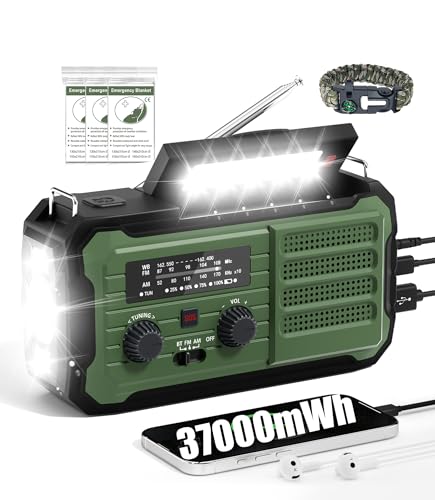
- 37,000mWh battery with solar and hand-crank charging
- Automatic scanning across seven NOAA channels
- Includes thermal blanket and multi-tool paracord bracelet
Best For: Campers and families building an emergency kit with added survival gear
Best High-Capacity Waterproof Option

- 74,000mWh battery with up to 35 hours of radio use
- IPX6 waterproofing and extended 52 cm antenna
- USB-C, solar, and hand-crank charging with bright lights
Best For: Users prioritizing long runtime and water resistance
Best with Extra Features

- 8500mm² monocrystalline solar panel
- Real 12000mAh battery with phone charging
- NOAA alerts, dual lights, and IPX6 waterproofing
Best For: Home emergency kits and hurricane preparedness
Best Audio and Alert Features

- Seven NOAA channels plus AM/FM reception
- 12000mAh battery and 8500mm² solar panel
- DSP audio, 57mm speaker, and 120dB SOS alarm
Best For: Storm kits, RVs, and clear emergency broadcasts
Best Compact Option
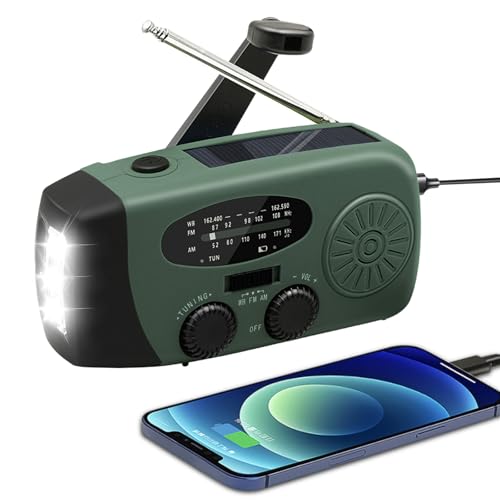
- Lightweight 231g portable design
- Solar, hand-crank, and rechargeable power
- 2000mAh charger, NOAA channels, and SOS siren
Best For: Go bags, car kits, and lightweight outdoor carry
Best All-Around Backup – FosPower A1 Emergency Radio
If you want emergency radios with solar charging for everyday preparedness, the FosPower A1 combines solar and hand-crank power with AAA-battery backup. It also receives AM/FM and NOAA broadcasts, includes two light sources, and can provide limited backup power for a phone or small tablet.
Best For: Home emergency kits, power outages, and buyers who want a compact radio with multiple backup functions.
Pros:
- 7,400mWh (2,000mAh) power bank for compatible small devices
- Solar, hand-crank, and AAA-battery power options
- NOAA, AM, and FM reception plus a flashlight and reading light
- Includes a limited lifetime warranty
Cons:
- The power bank is smaller than the 10,000mAh and 12,000mAh options in this roundup
- Requires four AAA batteries when rechargeable sources are unavailable
This is a well-rounded, portable choice when you value dependable radio access, lighting, and basic phone charging without needing the largest battery capacity.
Best High-Capacity Option – Roxicosly 12,000mAh Weather Radio
For shoppers comparing emergency radios with solar charging, this Roxicosly model stands out with a large solar panel and a stated 12,000mAh battery. It adds five charging methods, NOAA alerts, strong lighting, and IPX6 waterproof protection for more demanding emergency and outdoor use.
Best For: Extended outages, storm preparation, camping, and users who prioritize battery capacity and weather resistance.
Pros:
- Large 8,500mm² monocrystalline solar panel
- Stated 12,000mAh built-in battery for backup device charging
- 5W adjustable flashlight and 12-LED reading lamp
- IPX6 waterproof design with NOAA alerts and SOS alarm
Cons:
- At about 824g, it is heavier than the FosPower model
- Its larger body may be less convenient for minimalist kits
Choose this model if you want a rugged, feature-rich emergency radio with substantial stated battery capacity and stronger lighting for blackouts or outdoor trips.
Best for Realistic Charging Expectations – Leaton 10,000mAh Radio
The Leaton is one of the more transparent emergency radios with solar charging, explaining that its 10,000mAh battery delivers approximately 1–1.5 iPhone 14 charges after conversion losses. It supports solar, hand-crank, and USB-C charging, while its manual NOAA tuning and splash-resistant design suit straightforward emergency use.
Best For: Buyers who want a clearly described backup battery, manual controls, and a compact radio for home, vehicle, or outdoor kits.
Pros:
- 10,000mAh battery with realistic output guidance
- Solar, hand-crank, and USB-C charging
- NOAA, AM, and FM reception with large controls
- IPX6 water resistance, compass, flashlight, and reading lamp
Cons:
- Does not support SAME, automatic NOAA, or location-based alerts
- Manual tuning is required to find NOAA broadcasts
- Designed for splash resistance, not immersion or heavy rain
This is a sensible pick for preparedness shoppers who prefer honest charging expectations and simple operation over automatic alert features.
Best for Signal and Controls – 12,000mAh Clear-Signal Radio
If clear reception and easy handling matter when choosing emergency radios with solar charging, this 12,000mAh model emphasizes signal sensitivity, noise reduction, and an extended antenna. Its large solar panel, hand crank, USB-C input, lights, and large controls make it a versatile option for outages and off-grid use.
Best For: Households, travel kits, and older users who want clear AM/FM/NOAA reception and easy-to-use controls.
Pros:
- Signal chip, noise reduction, and extended antenna for reception
- 8,500mm² monocrystalline solar panel
- Stated 12,000mAh lithium battery with five power methods
- Large tuning knob, clear labels, flashlight, and reading lamp
Cons:
- Requires a full charge before first use for optimal performance
- The supplied notes do not specify automatic NOAA alert functionality
This model is appealing when usability and reception are as important as battery capacity, particularly for family emergency supplies and users who prefer large, clearly marked controls.
Best All-Around Alert Coverage – Raynic 5000mAh Emergency Radio
For shoppers comparing emergency radios with solar charging, the Raynic stands out for its automatic NOAA alert scanning, multiple backup power options, and useful lighting features. Its LCD display shows battery level and frequency, while AM/FM/SW/NOAA reception and a headphone jack make it practical for home preparedness and outdoor use.
Best For: Households wanting automatic weather alerts and several ways to keep a radio powered.
Pros:
- Automatically scans for NOAA emergency and weather alerts, including in standby mode.
- Offers six charging options: rechargeable battery, AC adapter, USB input, hand crank, solar panel, and three AAA batteries.
- Includes a 3W flashlight, 2.5W reading lamp, USB device charging, SOS siren, and 3.5 mm headphone jack.
- Has a large LCD display, digital tuning, power-saving dimmer, and IPX3 water resistance.
Cons:
- AAA batteries are not included.
- Its IPX3 rating is suited to light water exposure rather than heavy weather.
- The unit weighs about 1.2 pounds, so smaller emergency kits may favor a lighter radio.
The Raynic is a balanced choice when alert automation matters as much as charging flexibility. It combines broad reception, lighting, device charging, and an SOS function without relying on solar power alone.
Best Survival Kit Bundle – 10000mAh Emergency Weather Radio
This emergency radio with solar charging pairs a 37,000mWh rechargeable battery with hand-crank and solar charging. It also includes an emergency thermal blanket and a survival paracord bracelet, making the package more than a radio for shoppers building a compact outdoor or disaster-preparedness kit.
Best For: Campers and families seeking a radio bundled with basic signaling, warmth, and survival accessories.
Pros:
- Combines a 37,000mWh battery with hand-crank and solar charging.
- Automatically scans seven NOAA weather-band channels, including in standby mode.
- Includes a flashlight, headphone jack, USB port for smart-device charging, and SOS siren with flashing red light.
- Comes with a lightweight thermal blanket and a paracord bracelet with compass, cutting blade, whistle, and magnesium fire rod.
Cons:
- The supplied details do not specify a water-resistance rating or display type.
- The extra survival accessories may be unnecessary if you already own a preparedness kit.
- Only three charging methods are listed, so it lacks the broader power-source selection of some radios.
This model is compelling for buyers who value included survival gear and automatic alerts. Its accessory bundle adds practical utility for camping, hiking, and emergency storage, while the high-capacity battery is designed for extended use.
Best High-Capacity Waterproof Option – QAUYYW 20000mAh Solar Radio
For emergency radios with solar charging that prioritize battery capacity, the QAUYYW offers a 20,000mAh battery rated at 74,000mWh. It supports USB Type-C, solar, and hand-crank charging, and adds IPX6 waterproofing, long operating claims, bright lights, and a 52 cm antenna for home or outdoor preparedness.
Best For: Users who want extended battery capacity and stronger water protection for outages or outdoor trips.
Pros:
- Large 20,000mAh battery is rated for up to 35 hours of radio use at medium volume.
- Supports USB Type-C, solar-panel, and hand-crank charging.
- Includes 3W flashlights, a 3.5W reading lamp, USB charging output, and an SOS alarm.
- IPX6 waterproofing and a 52 cm extended antenna support outdoor use and signal reception.
Cons:
- NOAA alerts require the radio to be powered on and manually tuned to a local weather station.
- It does not provide automatic standby alert scanning according to the supplied notes.
- The three charging modes offer fewer options than radios that also accept AC or replaceable batteries.
The QAUYYW is a strong fit when runtime and weather resistance take priority. Its manual NOAA setup is less convenient for unattended alerts, but the large battery, IPX6 rating, lighting, and USB output make it well suited to extended outages and outdoor use.
Best with Extra Features – Large-Panel Emergency Radio
For shoppers comparing emergency radios with solar charging, this rugged model stands out with an oversized 8500mm² monocrystalline solar panel, a claimed real 12000mAh battery, and five charging methods. It also combines NOAA alerts, dual lighting, phone charging, and an SOS alarm for blackout and storm preparedness.
Best For: Home emergency kits, hurricane preparedness, and buyers who prioritize battery capacity and multiple backup power options.
Pros:
- Large solar panel plus hand crank, USB-C, built-in battery, and AAA battery options.
- 12000mAh battery can power the radio, lights, and emergency phone charging.
- 5W adjustable flashlight and 12-LED reading lamp provide two useful lighting modes.
- IPX6 waterproofing, NOAA alerts, and a loud SOS alarm suit severe-weather use.
Cons:
- Its larger battery and rugged construction may be more than minimalist kits need.
- AAA batteries are required for the alternate battery-power option.
This is the strongest choice here for extended preparedness, especially if phone charging and lighting matter as much as receiving weather broadcasts.
Best Audio and Alert Features – NOAA Solar Hand-Crank Radio
This emergency radio with solar charging pairs a large 8500mm² panel and hand crank with a 12000mAh rechargeable battery. DSP signal processing, seven NOAA weather broadcasts, a 57mm speaker, and a 120dB SOS alarm make it a practical option when clear updates and audible alerts are priorities.
Best For: Storm kits, RVs, camping, and users who want clear broadcast audio alongside backup lighting and phone charging.
Pros:
- Receives AM/FM and seven NOAA weather broadcasts when powered on and tuned appropriately.
- 12000mAh battery supports the radio, lights, SOS function, and emergency USB charging.
- DSP processing and a 57mm speaker are designed for clearer, room-filling sound.
- Large solar panel, hand crank, USB-C input, flashlight, and reading lamp provide flexible backup use.
Cons:
- NOAA alerts require the radio to be powered on and tuned to a NOAA station.
- The listed power setup requires a C battery for its battery-powered option.
Choose this model if broadcast readability and a prominent SOS alarm are especially important, while still retaining the convenience of solar and crank charging.
Best Compact Option – Pocket Solar Weather Radio
Among emergency radios with solar charging, the compact WVL model is designed for portability rather than maximum battery capacity. It weighs 231g and offers solar, hand-crank, and built-in rechargeable power, along with AM/FM/WB reception, a flashlight, reading lamp, phone charging, and an SOS siren.
Best For: Go bags, car kits, hiking, and shoppers who want a lightweight emergency radio with basic lighting and charging functions.
Pros:
- Compact 5.9-by-3.07-by-2.4-inch design and 231g weight are easy to carry.
- Three power sources—solar, hand crank, and built-in Li-ion battery—support emergency use.
- Includes AM/FM/WB preset NOAA channels, a 1.5W flashlight, reading lamp, and SOS alarm.
- 2000mAh phone charger can provide emergency power to a small phone or tablet.
Cons:
- The 2000mAh charger is substantially smaller than the 12000mAh batteries in the other listed models.
- Its specifications list three-band reception and a single AAA battery, so it offers fewer reception and battery options.
- Warranty information lists one year, despite the notes also mentioning 18-month returns and lifetime technical support.
This is the most travel-friendly pick for lightweight emergency storage, but users preparing for prolonged outages may prefer a higher-capacity model.
How We Picked the Best Emergency Radios with Solar Charging
We focused on features that matter during outages, storms, evacuations, and camping trips: NOAA weather-band reception, AM/FM coverage, battery capacity, solar and hand-crank charging, flashlight functions, and phone-charging capability. We also considered whether each radio appears practical to carry, operate, and recharge when wall power is unavailable.
Battery ratings can vary by manufacturer and may describe different units, such as milliamp-hours or watt-hours. Treat capacity as a useful comparison point rather than a guarantee of phone charges or runtime.
Quick Comparison
- Best overall balance: Look for a model combining NOAA alerts, multiple charging methods, useful lighting, and a mid-to-large battery.
- Best for extended outages: Prioritize the highest practical battery capacity, plus solar charging and a reliable hand crank.
- Best for portability: Choose a compact radio with a simpler control layout and enough battery for essential alerts.
- Best for broader listening: Models with AM/FM, NOAA, and SW bands offer more listening flexibility, although reception depends on location and conditions.
Key Buying Factors for Emergency Radios with Solar Charging
Charging Options
Solar charging is useful for maintaining power over time, but it is generally slow and depends on strong, direct sunlight. A hand crank is more dependable for short emergency sessions, while USB or wall charging is fastest when electricity is available. The best Emergency Radios with Solar Charging support several methods instead of relying on solar alone.
Weather Alerts and Reception
NOAA weather-band support is essential for storm information in supported areas. An alert function can be especially useful when you are not actively listening. AM/FM reception adds everyday utility, while shortwave support may expand listening options but is not necessary for every buyer.
Battery and Phone Charging
A larger battery can extend radio and light runtime and provide emergency phone charging. However, phone charging consumes power quickly, so do not treat these radios as substitutes for a dedicated power bank. Check the charging connector, output compatibility, and stated capacity before relying on the feature.
Lighting and Durability
Look for a bright flashlight, reading lamp, or both if the radio will stay in an emergency kit. A clear display, sturdy crank, simple controls, and a design that can be stored easily are also valuable when conditions are dark, wet, or stressful.
Who Should Buy Which Emergency Radios with Solar Charging?
Home emergency kits: Choose a feature-rich model with NOAA alerts, a substantial battery, multiple charging methods, and phone charging.
Travelers and campers: Favor a lighter radio with solar maintenance charging, a dependable crank, weather alerts, and practical lighting.
Storm-prone households: Prioritize strong weather-band functionality, loud audio, easy controls, and enough battery capacity for repeated updates.
Minimalists: A simpler, compact model may be the better choice if you mainly need alerts, a flashlight, and occasional backup power. Whichever radio you select, test it before an emergency, keep it charged, and store it where everyone in the household can find it.