The best lightweight running watches make it easier to track pace, distance, heart rate, and training progress without weighing down your wrist. This roundup compares 10 options across Garmin, COROS, Amazfit, Samsung, and Xiaomi.
Whether you want focused run coaching, long battery life, smartwatch features, or an affordable GPS watch, the right choice depends on how you train and which features you will use most often.
Best 10 Lightweight Running Watches Picks for 2026
Best Everyday Running Pick

- 43 mm lightweight design with AMOLED display
- GPS, wrist heart rate, and adaptive workouts
- Up to 19 hours of GPS battery life
Best For: Everyday runners seeking training guidance and smartwatch features
Best Long-Battery Value

- Large 1.97-inch AMOLED display
- Up to 14 days of battery life
- 140+ sports modes with maps and navigation
Best For: Multisport training and users who dislike frequent charging
Best Training-Readiness Pick

- Lightweight 43 mm running design
- Up to 23 hours of GPS battery life
- Training readiness and adaptive Garmin Coach plans
Best For: Goal-oriented runners focused on recovery and structured plans
Best Ultralight GPS Watch

- Only 32 grams with the nylon band
- Up to 41 hours of continuous GPS
- 19-day daily battery and recovery metrics
Best For: Runners prioritizing minimal weight and long GPS sessions
Best Lightweight Fitness Band

- 36.8-gram design with a 1.6-inch AMOLED display
- Up to 14 days of battery life
- 101+ workout modes with health tracking
Best For: Android users seeking casual run and everyday fitness tracking
Best Lightweight GPS Running Watch

- 37-gram GPS running watch
- Multi-satellite positioning with PacePro tools
- Training plans for 5K, 10K, and half marathon
Best For: Structured run training and GPS-based workout tracking
Best Lightweight AMOLED GPS Watch

- Built-in five-system GNSS for phone-free positioning
- 1.96-inch AMOLED display with optional AOD
- Up to 18 days of typical-use battery life
Best For: Runners wanting a large display, GPS, and extended battery life
Best All-Around Pick

- Bright AMOLED display with built-in GPS
- Up to 11 days of smartwatch battery life
- 30-plus sports apps and wellness tracking
Best For: Runners wanting a versatile fitness smartwatch
Best Simple Training Watch

- Lightweight 37 g design with button controls
- Up to two weeks of smartwatch battery
- Suggested workouts and PacePro guidance
Best For: Runners focused on essential training features
Best Advanced Training Features
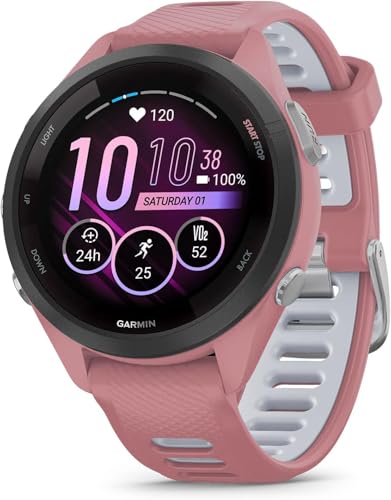
- Compact 42 mm AMOLED design for smaller wrists
- Training readiness and race-adaptive workouts
- Multi-band GNSS with SatIQ technology
Best For: Performance-focused runners seeking detailed training insights
Best Everyday Running Pick – Garmin Forerunner 165
For runners who want a lightweight running watch with a bright display and practical training guidance, the Garmin Forerunner 165 combines built-in GPS, wrist-based heart-rate tracking, and a 43 mm design. Its button-and-touch controls make it easy to check workout data while moving.
Best For: Everyday runners who want adaptive workouts, recovery insights, and smartwatch features in a compact design.
Pros:
- Built-in GPS and wrist-based heart-rate tracking measure pace, distance, and effort.
- AMOLED touchscreen works alongside traditional button controls.
- Up to 11 days in smartwatch mode and up to 19 hours in GPS mode.
- Includes suggested workouts, Garmin Coach plans, training effect, and recovery time.
Cons:
- Safety features require a compatible smartphone and network coverage.
- Some health and recovery metrics are estimates rather than medical measurements.
The Forerunner 165 is a well-rounded option for runners who want focused training tools without giving up notifications, Garmin Pay, or broader activity tracking.
Best Long-Battery Value – Amazfit Bip 6
The Amazfit Bip 6 is a lightweight running watch for athletes who prioritize a large, bright screen and long battery life. It adds built-in GPS, downloadable maps, turn-by-turn directions, and more than 140 workout modes while remaining compatible with iOS and Android.
Best For: Multisport users who want extended battery life, broad activity tracking, and an easy-to-read display.
Pros:
- Lightweight aluminum build and vivid 1.97-inch AMOLED display.
- Up to 14 days of battery life reduces charging interruptions.
- Supports five satellite systems, downloadable maps, and turn-by-turn navigation.
- Tracks heart rate, sleep, blood oxygen, stress, and more than 140 workout types.
Cons:
- Its larger rectangular case may be less compact than dedicated running watches.
- The charging package includes a magnetic base but no USB-C cable.
Choose the Bip 6 if you want a versatile fitness watch with strong battery endurance and navigation features rather than a narrowly running-focused training ecosystem.
Best Training-Readiness Pick – Garmin Forerunner 70
The Garmin Forerunner 70 is a lightweight running watch built around structured training and recovery. Its built-in GPS, wrist-based heart rate, AMOLED screen, and Garmin Coach plans support both beginner run/walk programs and higher-intensity training.
Best For: Runners who want adaptive plans, training-readiness insights, and detailed recovery information.
Pros:
- Built-in GPS tracks pace and distance, while wrist-based heart rate monitors effort.
- Personalized daily workouts adapt to performance and recovery.
- Up to 13 days in smartwatch mode and up to 23 hours in GPS mode.
- Includes sleep score, training readiness, training status, and recovery time features.
Cons:
- The supplied details list the device as not water resistant despite a 50-meter water-resistance depth specification.
- Live-location safety features require smartphone pairing and network coverage.
The Forerunner 70 stands out for runners who want more comprehensive readiness and recovery guidance, especially when following a goal-oriented training plan.
Best Ultralight GPS Watch – COROS PACE 4
At 32 grams with its nylon band and 11.8 mm thickness, the COROS PACE 4 is an especially lightweight running watch for athletes who dislike bulk. It pairs a 1.2-inch AMOLED display with long battery life, tactile controls, voice features, and detailed training and recovery data.
Best For: Serious runners and multisport athletes who want minimal weight, extended GPS use, and training-focused analytics.
Pros:
- Ultralight 32-gram design is suited to 24/7 wear.
- Provides up to 41 hours of continuous GPS use and up to 19 days of daily battery life.
- Combines a digital crown, buttons, and touchscreen for flexible control.
- Tracks recovery time, sleep stages, HRV, and menstrual cycles through the COROS app.
Cons:
- Its water-resistance specification is listed as 5 meters, so it is less suitable for water-focused activities.
- The supplied notes do not list onboard mapping or a broad set of specific activity profiles.
The PACE 4 is the clearest choice here for minimizing wrist weight while maximizing GPS endurance, making it appealing for long training sessions and daily wear.
Best Lightweight Fitness Band – Samsung Galaxy Fit3
The Samsung Galaxy Fit3 is a slim, 36.8-gram option for shoppers comparing lightweight running watches for everyday activity tracking. Its bright 1.6-inch AMOLED display, automatic workout detection, and long battery life make it better suited to casual runs and general fitness than GPS-focused training.
Best For: Android users who want a lightweight fitness tracker with a large display and extended battery life.
Pros:
- Large, high-resolution 1.6-inch AMOLED touchscreen.
- Up to 14 days of battery life for fewer charging interruptions.
- Tracks 101+ workout modes, sleep, heart rate, and blood oxygen.
- 5ATM and IP68 water resistance support swimming and active use.
Cons:
- No built-in GPS for tracking outdoor routes without a phone.
- Compatible only with Android 10 and newer devices.
- International model has no US warranty, and Samsung Pay is not supported.
The Galaxy Fit3 is appealing when comfort, screen quality, and battery longevity matter most. Runners who need onboard route tracking should choose a GPS-equipped model instead.
Best Lightweight GPS Running Watch – Garmin Forerunner 55
The Garmin Forerunner 55 is a practical choice among lightweight running watches for runners who want dedicated GPS training features. At 37 grams, it adds only minimal wrist weight while offering multi-satellite positioning, pace tools, recovery guidance, and structured training plans.
Best For: Runners training for 5K, 10K, or half-marathon distances who want built-in GPS and guided workouts.
Pros:
- Built-in GPS, GLONASS, and Galileo support for positioning.
- PacePro, finish-time estimates, and recovery-time features support training management.
- Includes suggested daily workouts and free 5K, 10K, and half-marathon plans.
- Waterproof to 50 meters with running, cycling, swimming, and other activity profiles.
Cons:
- Small 1.04-inch LCD display compared with larger AMOLED alternatives.
- Claimed battery life is up to 20 hours, so frequent GPS use requires more charging.
- Uses button controls rather than a touchscreen.
The Forerunner 55 is the strongest training-focused pick in this group. Its lighter build and dedicated running tools are more useful for structured workouts than a general-purpose fitness band.
Best Lightweight AMOLED GPS Watch – Xiaomi Redmi Watch 5 Lite
The Xiaomi Redmi Watch 5 Lite combines a large AMOLED screen with built-in GNSS, making it a versatile contender among lightweight running watches. It supports independent satellite positioning, more than 150 workout modes, and up to 18 days of typical-use battery life.
Best For: Runners who want a large, colorful display, onboard GPS, and long battery life at a fitness-watch price.
Pros:
- Built-in five-system GNSS supports phone-free workout positioning.
- Large 1.96-inch AMOLED display with optional always-on display.
- Up to 18 days of typical-use battery life.
- Offers 150+ workout modes plus heart-rate and blood-oxygen sensors.
Cons:
- At 81 milligrams as listed, it may not feel as light as the other options here.
- Battery performance varies with features and usage.
- Warranty information is limited to a 30-day Xiaomi Warranty Europe description.
The Redmi Watch 5 Lite is a well-rounded option for runners who prioritize screen size and battery endurance without giving up built-in positioning. Its larger body may be less appealing to shoppers seeking the lightest possible design.
Best All-Around Pick – Garmin vívoactive 5
The Garmin vívoactive 5 is a versatile choice for shoppers comparing lightweight running watches. Its bright AMOLED display, built-in GPS, running tools, and broad health-tracking features make it suitable for everyday training and general fitness.
Best For: Runners who want a colorful smartwatch with strong wellness tracking and multisport support.
Pros:
- Up to 11 days of battery life in smartwatch mode, or up to 5 days with the display always on.
- Includes more than 30 indoor and GPS sports apps, including running, cycling, swimming, and HIIT.
- Offers Body Battery, sleep coaching, nap detection, stress tracking, and recovery-oriented insights.
- Supports downloaded music from Spotify, Amazon Music, or Deezer for phone-free listening.
Cons:
- Its extensive health and smartwatch features may be more than runners seeking a simple training watch need.
- Music downloads require compatible accounts and wireless headphones.
Choose the vívoactive 5 if you want running functionality alongside a polished daily smartwatch experience. It is especially appealing for athletes who value battery life, wellness data, and activity variety.
Best Simple Training Watch – Garmin Forerunner 55
The Garmin Forerunner 55 keeps the focus on core training features, making it a practical option among lightweight running watches. It tracks pace, distance, and routes with GPS while adding suggested workouts and race-planning tools.
Best For: Runners who prefer straightforward training guidance, physical buttons, and long battery life.
Pros:
- Weighs 37 g and offers up to two weeks in smartwatch mode or 20 hours in GPS mode.
- Tracks how far, how fast, and where you run using wrist-based heart rate and GPS.
- Provides PacePro guidance, race time predictions, and finish-time estimates.
- Uses training history, fitness level, and recovery time to suggest workouts.
Cons:
- The sunlight-visible MIP display is less colorful than an AMOLED screen.
- PacePro is not compatible with on-device courses.
- Its feature set is centered more on running than broad smartwatch functionality.
The Forerunner 55 is a sensible pick when reliable running essentials matter more than a premium display or advanced multisport features. Its light weight, button controls, and generous battery rating suit regular training.
Best Advanced Training Features – Garmin Forerunner 265S
The renewed Garmin Forerunner 265S combines a lightweight 42 mm design with a colorful AMOLED touchscreen and advanced training metrics. For runners comparing lightweight running watches, its adaptive workouts, training readiness data, and multi-band GPS make it the most training-focused option here.
Best For: Performance-minded runners with smaller wrists who want detailed preparation and recovery feedback.
Pros:
- Compact 42 mm design fits wrists measuring 115–178 mm and weighs 39 g.
- Offers up to 15 days in smartwatch mode and up to 24 hours in GPS mode.
- Includes training readiness, HRV status, training status, morning reports, and race-adaptive plans.
- Multi-band GNSS with SatIQ technology is designed to improve positioning in challenging environments.
Cons:
- This is a renewed product, so condition and included coverage should be checked before purchase.
- Its advanced training data may be unnecessary for casual runners.
- Safety and smart notifications require a compatible paired smartphone, and some features require network coverage.
The Forerunner 265S is the strongest match for runners who actively use training-readiness and race-planning data. Its smaller case, AMOLED screen, and advanced GPS features offer a premium training package in a compact format.
How We Picked These Lightweight Running Watches
We focused on watches that are practical for running and comfortable enough for regular wear. Our comparison considers GPS capability, weight and case size, battery expectations, workout and training features, heart-rate tracking, water resistance, phone compatibility, display quality, and overall value.
The list includes dedicated running watches, multisport models, fitness trackers, and budget-friendly smartwatches. That range matters because a beginner may need only reliable pace tracking, while a serious runner may prioritize structured workouts, recovery metrics, and responsive GPS data.
Quick Comparison
- Best focused running experience: Garmin Forerunner 165, Garmin Forerunner 55, or COROS PACE 4.
- Best advanced training option: Garmin Forerunner 265S, especially for runners who want richer workout and training data.
- Best everyday fitness balance: Garmin vívoactive 5.
- Best budget-friendly smartwatch approach: Amazfit Bip 6 or Xiaomi Redmi Watch 5 Lite.
- Best simple fitness tracker: Samsung Galaxy Fit 3.
Key Buying Factors for Lightweight Running Watches
Weight, Fit, and Case Size
A lightweight watch should stay secure without bouncing or creating pressure points. Smaller cases can suit narrow wrists, while a larger display may be easier to read during intervals. Check both the case dimensions and strap adjustability rather than judging comfort by weight alone.
GPS and Running Accuracy
Built-in GPS is important if you want pace, distance, and route data without carrying your phone. Look for dependable satellite support and consider whether you run in cities, wooded areas, or open spaces. Dual-band or enhanced positioning can be useful for runners who regularly train around tall buildings or dense tree cover.
Battery Life
Battery claims usually vary by mode. GPS tracking, music, bright displays, and frequent notifications can reduce runtime substantially. Choose a watch that can cover your longest training session with reserve power, and consider charging habits if you dislike frequent recharging.
Training and Health Features
Basic models may provide pace, laps, heart rate, and suggested workouts. More advanced watches can add recovery guidance, training readiness, structured workouts, navigation, and broader multisport support. Select features that match your goals instead of paying for data you will not review.
Smartwatch Compatibility and Durability
Confirm iPhone or Android compatibility before buying, particularly with international models. Also check water resistance, screen visibility, notification support, and whether the watch offers onboard music or contactless features if those matter to you.
Who Should Buy Which Lightweight Running Watches?
New runners should prioritize simple controls, dependable GPS, comfortable sizing, and guided workouts. A Garmin Forerunner 55 or Forerunner 165 is a sensible starting point.
Performance-focused runners should look toward the COROS PACE 4 or Garmin Forerunner 265S for deeper training support and more room to progress.
Everyday fitness users may prefer the Garmin vívoactive 5, Amazfit Bip 6, or Xiaomi Redmi Watch 5 Lite for a broader mix of health, workout, and smartwatch functions.
Shoppers who mainly want basic activity tracking can consider the Samsung Galaxy Fit 3, particularly if long battery life and a slim design matter more than advanced running analysis.