When severe weather or a power outage cuts off normal communication, a compact emergency radio can provide vital forecasts, alerts, light, and backup charging in one portable device.
We selected 10 emergency radios with practical combinations of NOAA access, AM/FM reception, hand-crank or solar charging, batteries, flashlights, and phone-power features to help you choose confidently.
Best 10 Compact Emergency Radios Picks for 2026
Best All-Around Pick
RunningSnail Compact Emergency Radio

- NOAA/AM/FM reception
- Hand crank, solar, and battery power
- 2,000mAh charger and 1W flashlight
Best For: Households and campers needing versatile emergency backup
Best Simple Battery Model
PRUNUS J161 Portable NOAA Radio

- Seven NOAA weather bands
- Two-AA battery operation
- Simple controls and headphone jack
Best For: Users wanting an uncomplicated battery-powered backup
Best Lightweight Carry Option

- AM/FM reception
- Flashlight and SOS strobe
- Three AA batteries included
Best For: Portable everyday carry and basic emergency signaling
Best Lighting and Power Backup

- AM/FM/weather-band reception
- 2,000mAh power bank
- Four power options and dual lighting
Best For: Emergency kits needing charging and substantial lighting
High-Capacity All-Rounder
PRUNUS J-369 Emergency Weather Radio

- NOAA, AM, and FM reception with an extra-long antenna
- Five power options, including solar and hand crank charging
- 3,000mAh battery, lights, SOS alarm, and phone charging
Best For: Blackout kits, camping, and multi-function emergency preparedness
Pocket-Size Essential

- Lightweight, pocket-friendly AM/FM/NOAA design
- USB, solar, and hand-crank charging
- 140-lumen flashlight, 2,000mAh battery, and SOS alarm
Best For: Portable kits, car storage, camping, and lightweight carry
Maximum Backup Power
NITIGO 4000mAh Emergency Weather Radio

- 4,000mAh battery supports emergency USB device charging
- NOAA, AM, and FM reception with a high-gain antenna
- Flashlight, rotating reading lamp, SOS alarm, and headphone jack
Best For: Extended outages, family preparedness, and remote outdoor use
Best High-Capacity Pick
Leaton 10,000mAh Hand Crank Radio

- 10,000mAh battery with USB phone output
- Solar, hand-crank, and USB-C charging
- Flashlight, reading lamp, compass, and NOAA reception
Best For: Emergency kits and outdoor users needing extra backup power
Best Lightweight Option
WVL Compact Solar Hand Crank Radio
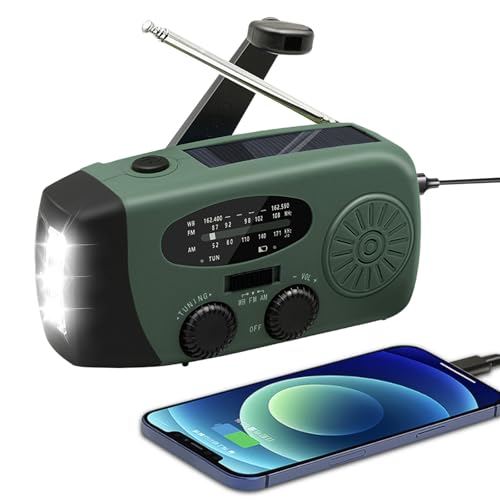
- Compact 231-gram design
- AM/FM/NOAA radio with flashlight and SOS alarm
- Hand-crank, solar, and rechargeable power
Best For: Lightweight go-bags, car kits, and camping
Best Feature-Rich Rugged Pick
Roxicosly Large-Panel Emergency Radio

- 12,000mAh battery and five charging methods
- Large solar panel with efficient hand crank
- NOAA alerts, dual lights, SOS alarm, and IPX6 protection
Best For: Storm preparedness and outdoor users wanting maximum versatility
Best All-Around Pick – RunningSnail Compact Emergency Radio
For shoppers comparing compact emergency radios, the RunningSnail MD-088s combines weather access, backup power, and lighting in a small 5-by-1.8-by-2.4-inch design. Its NOAA/AM/FM tuning, 2,000mAh battery, hand crank, solar charging, and USB-C connectivity make it a versatile option for outages, camping, and emergency kits.
Best For: Households and campers wanting one compact radio with multiple power options and phone-charging capability.
Pros:
- Receives NOAA, AM, and FM broadcasts with a retractable antenna.
- Offers hand-crank, solar, and rechargeable-battery power.
- Includes a 2,000mAh emergency charger and bright 1W flashlight.
- Lightweight design weighs 7.84 ounces.
Cons:
- Its water resistance is listed as water repellent rather than fully waterproof.
- The built-in battery may require recharging before extended use.
The RunningSnail is a strong general-purpose choice when you want compact size without giving up charging flexibility, weather broadcasts, or illumination.
Best Simple Battery Model – PRUNUS J161 Portable NOAA Radio
The PRUNUS J161 is a straightforward choice among compact emergency radios, measuring 4.7 by 2.8 by 1.2 inches and weighing 0.24 pound without batteries. It uses two AA batteries and provides NOAA, AM, and FM reception through simple controls, making it easy to keep in an emergency kit or backpack.
Best For: Users who prefer a lightweight, easy-to-operate radio powered by replaceable AA batteries.
Pros:
- Covers seven NOAA weather bands along with AM and FM.
- Runs on two widely available AA batteries.
- Three basic controls simplify power, volume, tuning, and band selection.
- Includes a lanyard and headphone jack for portable listening.
Cons:
- It does not support automatic NOAA alert notifications.
- It has no listed flashlight, hand crank, solar charging, or power-bank function.
This PRUNUS radio keeps the focus on accessible weather and broadcast listening, making it a practical low-complexity backup when you can store spare batteries.
Best Lightweight Carry Option – Midland ER10VP Weather Radio
The Midland ER10VP is a compact emergency radio designed for easy carrying, with AM/FM reception, a built-in flashlight, and an SOS strobe signal. It includes three AA batteries and a headphone jack, giving you a simple way to follow broadcasts or carry a small emergency light.
Best For: Walkers, commuters, and emergency-kit users prioritizing portability and basic alert features.
Pros:
- Includes AM/FM radio reception and a built-in antenna.
- Provides a flashlight and SOS strobe signal.
- Comes with three AA batteries included.
- Offers a headphone jack for private listening.
Cons:
- The supplied notes do not list NOAA weather-band reception.
- It is not water resistant.
- Its listed dimensions are unusual and provide limited size detail.
The Midland is best viewed as a lightweight AM/FM companion with emergency lighting and signaling rather than a feature-heavy weather radio.
Best Lighting and Power Backup – FosPower A1 Emergency Radio
The FosPower A1 stands out among compact emergency radios for its combination of broadcast access, lighting, and backup charging. It receives AM, FM, and weather-band broadcasts, includes a 2,000mAh power bank, and offers solar, hand-crank, rechargeable, and AAA-battery power options.
Best For: Emergency kits and outdoor use where lighting, device charging, and flexible power sources are priorities.
Pros:
- Receives AM, FM, and weather-band broadcasts.
- Provides a 2,000mAh power bank for small tablets or phones.
- Uses solar, hand-crank, rechargeable, and AAA-battery power options.
- Includes a 1W flashlight, four-LED reading light, and SOS alarm.
Cons:
- At 310 grams and 6.2 inches long, it is heavier and larger than some compact models.
- Requires four AAA batteries when external regeneration is unavailable.
The FosPower A1 is a capable all-in-one emergency tool, especially for buyers willing to accept extra size in exchange for stronger lighting and power redundancy.
High-Capacity All-Rounder – PRUNUS J-369 Emergency Weather Radio
The PRUNUS J-369 is a versatile choice among compact emergency radios, combining NOAA, AM, and FM reception with multiple backup power options. Its extra-long antenna and DSP chip are designed to help with signal reception when regular communications are unavailable.
Best For: Home blackout kits, outdoor trips, and shoppers who want a higher-capacity radio with lighting and phone-charging capability.
Pros:
- Supports NOAA weather, AM, and FM broadcasts.
- Offers five power options, including AA batteries, USB, solar, and hand crank charging.
- Includes a 3,000mAh rechargeable battery, flashlight, reading lamp, SOS alarm, and phone power-bank function.
Cons:
- AA batteries are not included.
- Phone charging requires switching the radio to Li-ion mode.
- The AA batteries power the radio only and cannot charge other devices.
The PRUNUS J-369 stands out for its combination of capacity, flexible charging, and useful emergency accessories. It is a strong fit if you want one compact radio to cover alerts, lighting, and basic backup power.
Pocket-Size Essential – Esky ES-CR01 Emergency Radio
For shoppers prioritizing portability, the Esky ES-CR01 is one of the most compact emergency radios in this lineup. It provides AM, FM, and NOAA weather reception in a lightweight body that can fit in a pocket, trunk, or emergency bag.
Best For: Pocket carry, car emergency kits, camping, and anyone who wants a lightweight radio with straightforward backup charging.
Pros:
- Compact 5-by-1.8-by-2.4-inch design weighs 7.55 ounces.
- Charges through USB, solar power, or the hand crank.
- Includes a 2,000mAh battery, 140-lumen three-LED flashlight, and SOS alarm.
Cons:
- Its 2,000mAh battery is smaller than some alternatives in this roundup.
- Battery runtime is listed at approximately 20 hours for the flashlight or 9 hours for the radio when fully charged.
- Regular charging is recommended when the radio is stored.
The Esky ES-CR01 keeps the feature set practical without adding much bulk. Its lightweight build and lanyard make it especially convenient for portable emergency storage and outdoor use.
Maximum Backup Power – NITIGO 4000mAh Emergency Weather Radio
The NITIGO is a capable option for compact emergency radios when extended backup power and clear reception matter most. It combines NOAA, AM, and FM tuning with a high-gain antenna, a 4,000mAh battery, and several ways to keep the unit operating.
Best For: Families preparing for extended outages, travelers, and outdoor users who want phone backup power plus versatile lighting.
Pros:
- 4,000mAh rechargeable battery can provide emergency power to USB devices.
- Supports USB, solar, and hand-crank charging.
- Includes a high-gain antenna, flashlight, rotating reading lamp, SOS alarm, flashing light, and headphone jack.
Cons:
- The larger battery and feature set may be more than needed for basic radio listening.
- Its listed interfaces and controls may require more setup than a simpler emergency radio.
With the largest stated battery capacity of these three models, the NITIGO is built for more demanding preparedness needs. Its combination of reception features, device charging, and lighting makes it a strong choice for longer outages or remote trips.
Best High-Capacity Pick – Leaton 10,000mAh Hand Crank Radio
For shoppers comparing compact emergency radios, the Leaton stands out when backup phone power matters most. Its 10,000mAh internal battery, USB-C input, solar charging, and hand crank provide several ways to stay powered during outages or outdoor trips. The compact 6.3-by-3.5-by-3.1-inch design also fits readily in a go-bag, vehicle, or RV.
Best For: Emergency kits and outdoor users who prioritize battery capacity, lighting, and multiple charging options.
Pros:
- Large 10,000mAh battery with USB phone-charging output.
- Supports USB-C, solar, and hand-crank charging.
- Includes AM/FM and NOAA reception, a three-mode flashlight, reading lamp, and compass.
- IPX6 water resistance helps protect against splashes and spray.
Cons:
- Manual NOAA tuning is required; it does not provide SAME or automatic alerts.
- The stated battery capacity typically provides about 1–1.5 iPhone 14 charges after conversion losses.
- IPX6 protection is for splash resistance, not immersion or heavy rain.
The Leaton is a practical, feature-rich choice if you want substantial reserve power in a relatively compact radio. Its manual weather tuning and splash-only protection are important limitations to understand before buying.
Best Lightweight Option – WVL Compact Solar Hand Crank Radio
The WVL is a strong choice for anyone seeking compact emergency radios that are easy to carry. Measuring 5.9 by 3.07 by 2.4 inches and weighing 231 grams, it fits well in small emergency bags while still offering AM/FM and preset NOAA weather reception, lighting, an SOS alarm, and emergency charging.
Best For: Lightweight go-bags, car kits, camping, and users who want essential radio and lighting functions without much bulk.
Pros:
- Pocket-sized design with a listed weight of 231 grams.
- Offers hand-crank, solar, and built-in rechargeable-battery power sources.
- Combines AM/FM/NOAA reception, a 1.5W flashlight, reading lamp, and SOS alarm.
- Includes a 2,000mAh phone-charging function and 18-month returns with lifetime technical support.
Cons:
- The 2,000mAh charger offers less reserve capacity than larger emergency radios.
- Its analog tuning and preset NOAA channels may be less flexible than digital alert systems.
- The supplied notes do not specify a water-resistance rating.
The WVL keeps the essentials in a notably small package. It is best suited to buyers who value portability over maximum phone-charging capacity and advanced weather-alert features.
Best Feature-Rich Rugged Pick – Roxicosly Large-Panel Emergency Radio
Among compact emergency radios, this Roxicosly model is aimed at buyers who want robust charging and alert features in one unit. It combines a large 8,500mm² solar panel, hand-crank generator, 12,000mAh battery, five charging methods, dual lights, NOAA alerts, and an SOS alarm for home preparedness or outdoor use.
Best For: Storm preparedness and outdoor users who want high battery capacity, multiple charging methods, and automatic NOAA alert functionality.
Pros:
- Large solar panel and claimed 12,000mAh rechargeable battery.
- Supports built-in battery, USB-C, solar, hand crank, and AAA batteries.
- Includes a 5W adjustable flashlight and 12-LED reading lamp.
- Features AM/FM/NOAA reception, NOAA alerts, a 9-second alarm, and IPX6 waterproofing.
Cons:
- At 6.8 by 2.88 by 4.74 inches, it is taller and less pocket-friendly than some compact models.
- It requires three AAA batteries for its battery-powered option.
- The supplied details do not specify the phone-charge amount users can expect from the 12,000mAh rating.
This is the most feature-heavy option of the three, particularly for users who value NOAA alerts and extensive power flexibility. Its larger profile may matter if you need the smallest possible radio for a pocket or minimalist kit.
How We Picked These Compact Emergency Radios
We focused on features that matter when the power is out or conditions are changing quickly: NOAA weather-band access, readable controls, multiple charging methods, useful battery capacity, dependable lighting, and portability. We also considered whether each radio is best suited to everyday preparedness, travel, camping, or longer outages.
Specifications can vary by model and seller, so verify current battery capacity, included cables, charging instructions, and alert functionality before purchasing. A hand crank and solar panel are valuable backups, but neither should be treated as a fast replacement for wall or USB charging.
Quick Comparison
| Priority | Look for | Best fit |
|---|---|---|
| Simple outage backup | AM/FM, NOAA, AA or rechargeable battery, flashlight | Homes and apartments |
| Longer runtime | Larger battery capacity and USB output | Extended outages and emergency kits |
| Off-grid charging | Solar panel plus hand crank | Camping and remote locations |
| Easy portability | Compact housing, light weight, and carry strap | Go-bags and travel |
Key Buying Factors for Compact Emergency Radios
Weather Alerts and Reception
NOAA capability is useful only when the radio can receive a signal in your area. Check whether the model offers alert mode, not just weather-band tuning, and look for an extendable antenna or clear reception controls.
Power and Charging Options
Multiple power sources improve resilience. Rechargeable batteries are convenient for regular use, while AA models can be easier to replenish from a stored battery supply. Solar charging is slow but useful over time; hand cranks are dependable when no other source is available.
Battery Capacity and Phone Charging
Higher mAh or mWh ratings generally provide more reserve power, but actual phone charging depends on output, cable compatibility, and conversion losses. Treat USB charging as an emergency boost rather than a full phone recharge.
Lighting and Controls
A focused flashlight helps with navigation, while a reading lamp can illuminate a room or tent. Choose controls that are easy to identify in darkness and confirm that the radio can operate without relying on a phone app.
Who Should Buy Which Compact Emergency Radios?
Choose a basic AA-powered weather radio if you want a straightforward home backup with minimal charging maintenance. Pick a rechargeable hand-crank and solar model for a general emergency kit or go-bag. For extended outages, prioritize a larger battery, USB output, and multiple lighting modes. Campers and remote travelers should favor compact construction, a carry-friendly design, and reliable manual charging. If your main concern is severe weather, place NOAA access and alert functionality ahead of decorative features or maximum battery size.