When severe weather cuts power or cellular service, a dependable emergency radio can provide critical alerts, flashlight access, and backup phone charging in one compact device.
We selected 10 emergency radios with practical combinations of NOAA reception, hand-crank and solar charging, battery capacity, lighting, and portability for different preparedness needs.
Best 10 Emergency Radios Picks for 2026
Best All-Around Power Backup
FosPower NOAA Emergency Radio A1

- 7,400mWh power bank for small-device charging
- Solar, hand-crank, USB-C, and AAA power options
- NOAA/AM/FM reception with flashlight and reading light
Best For: Households building a versatile outage-preparedness kit
Best for Built-In Emergency Alerts

- NOAA weather scan and alert functionality
- SOS flashlight and ultrasonic dog whistle
- Solar power plus six included AA batteries
Best For: Preparedness kits focused on weather monitoring and signaling
Best High-Capacity Outdoor Option
Roxicosly 12000mAh Emergency Radio

- Stated 12,000mAh battery for emergency charging
- Large solar panel and efficient hand-crank generator
- IPX6 waterproofing with bright dual lighting
Best For: Outdoor use and extended blackout preparedness
Best Compact Budget-Friendly Pick

- Lightweight, pocket-sized design
- AM/FM/NOAA reception with 140-lumen flashlight
- 2,000mAh battery with solar, crank, and Type-C charging
Best For: Go-bags, travel, and compact home emergency kits
Versatile Classic

- AM/FM, shortwave, and seven NOAA channels
- Multiple charging methods with USB device output
- Reading lamp, flashlight, and SOS beacon
Best For: Broad radio coverage and flexible backup power
Best for Everyday Use
Leaton 10000mAh Emergency Radio

- Large battery with USB phone-charging output
- Solar, hand-crank, and USB-C charging
- IPX6 splash resistance with compass and lighting
Best For: Outdoor kits needing extended backup power
Alert-Ready Digital Choice
Raynic Automatic NOAA Weather Radio

- Automatic NOAA alert scanning in standby
- AM/FM, shortwave, and weather-band reception
- Six charging options with lighting and SOS alarm
Best For: Automatic weather notifications and digital tuning
High-Capacity Pick
Rugged 12,000mAh Emergency Radio

- 12,000mAh battery with solar, crank, USB-C, and AAA backup
- NOAA, AM, and FM reception with extended antenna
- 5W flashlight, reading lamp, SOS alarm, and rugged water-resistant design
Best For: Extended backup power and rugged emergency preparedness
Versatile Listening Pick
NOAA Alert Radio with Shortwave
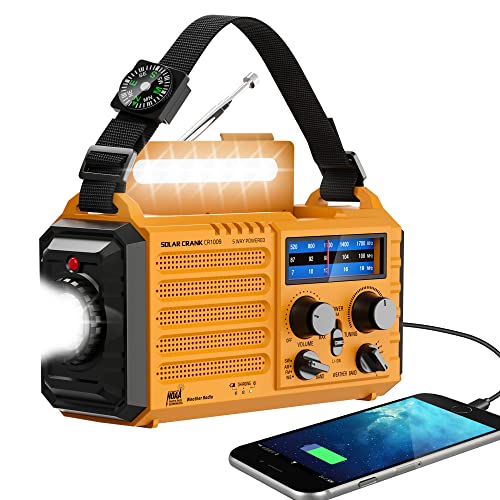
- AM, FM, shortwave, and seven NOAA weather bands
- NOAA alerts include an audible alarm and flashing light
- Flashlight, reading lamp, compass, headphone jack, and USB output
Best For: Flexible listening and compact outdoor use
Alert-Focused Pick
Digital 12,000mAh Weather Radio

- Automatic NOAA alerts work in standby mode
- 12,000mAh battery and six charging options
- HD LCD, AM/FM/SW/WB reception, lights, SOS, and headphone jack
Best For: Automatic weather warnings and flexible recharging
Best All-Around Power Backup – FosPower NOAA Emergency Radio A1
For shoppers comparing emergency radios, the FosPower A1 combines NOAA, AM, and FM reception with multiple ways to stay powered. Its 7,400mWh power bank, solar panel, hand crank, AAA-battery compatibility, lights, and SOS alarm make it a versatile choice for outages and outdoor emergencies.
Best For: Households wanting a balanced emergency radio with phone charging, weather updates, and useful lighting.
Pros:
- 7,400mWh (2,000mAh) power bank can charge a phone or small tablet.
- Supports solar, hand-crank, USB-C, and AAA-battery power options.
- Includes NOAA/AM/FM reception, a 1W flashlight, and a four-LED reading light.
- Limited lifetime warranty is included.
Cons:
- Requires four AAA batteries when rechargeable power sources are unavailable.
- Its power bank is better suited to small devices than extended, high-demand charging.
The FosPower is a well-rounded emergency radio for a preparedness kit, especially if you value several backup power methods and both directional and area lighting in one compact unit.
Best for Built-In Emergency Alerts – Midland ER310 Weather Radio
The Midland ER310 is a straightforward option among emergency radios, offering AM/FM reception, NOAA weather scan and alert functionality, and multiple emergency-oriented features. Its built-in flashlight, SOS signaling, and ultrasonic dog whistle add utility beyond listening to broadcasts.
Best For: Buyers who prioritize weather alerts and practical signaling features in a simple emergency radio.
Pros:
- NOAA weather scan and alert feature helps monitor emergency conditions.
- Multiple power sources are supported, including solar power and six included AA batteries.
- Includes an SOS emergency flashlight and ultrasonic dog whistle.
Cons:
- Supports AM/FM rather than the broader AM/FM/NOAA band description found on some competing models.
- It is not water resistant.
- Only a one-year limited warranty is listed.
The ER310 suits emergency kits that need weather monitoring and attention-getting tools without emphasizing a large phone-charging battery. Its lack of water resistance makes protected storage important.
Best High-Capacity Outdoor Option – Roxicosly 12000mAh Emergency Radio
For shoppers seeking emergency radios with substantial backup power, this Roxicosly model pairs a stated real 12,000mAh battery with a large solar panel and hand-crank generator. It also adds AM/FM/NOAA reception, IPX6 waterproofing, dual lights, and an SOS alarm for blackout and outdoor use.
Best For: Outdoor users and households wanting higher-capacity device charging, bright lighting, and weather protection.
Pros:
- Stated 12,000mAh battery provides substantial emergency power for phones and lights.
- Large 8,500mm² monocrystalline solar panel and efficient hand crank support recharging.
- Features a 5W adjustable flashlight and 12-LED reading lamp.
- IPX6 waterproof construction, NOAA alerts, and a loud SOS alarm add emergency utility.
Cons:
- At 824g, it is considerably heavier than pocket-sized emergency radios.
- Its larger battery and rugged design may be more than needed for a minimal home kit.
This is the feature-heavy pick for users who want a radio that can double as a serious backup battery and lighting device. The added capacity and waterproofing come with greater weight.
Best Compact Budget-Friendly Pick – Emgykit Hand Crank Radio
The Emgykit is a compact choice for shoppers who want essential emergency radios without carrying a bulky device. It provides AM/FM/NOAA access, hand-crank and solar charging, a 2,000mAh rechargeable battery, a bright three-LED flashlight, and an SOS alarm in a lightweight body.
Best For: Lightweight emergency kits, travel, and users who want basic weather access and phone backup power.
Pros:
- Small 5.16-by-2.09-by-2.6-inch design weighs about 0.23kg.
- Supports hand-crank, solar, and Type-C charging.
- Includes AM/FM/NOAA reception, a 140-lumen three-LED flashlight, and an SOS alarm louder than 80 decibels.
- Built-in 2,000mAh rechargeable battery can provide emergency phone charging.
Cons:
- Its 2,000mAh battery offers less capacity than larger emergency-radio models.
- Plastic construction and compact size may provide fewer rugged-use advantages than heavier outdoor models.
The Emgykit makes sense when portability matters most. It covers the core radio, lighting, alert, and backup-charging functions while remaining easy to store in a go-bag or drawer.
Versatile Classic – Kaito KA500 Emergency Radio
The Kaito KA500 is a flexible choice among emergency radios, combining AM/FM, shortwave, and NOAA weather coverage with several ways to stay powered. Its crank, solar panel, rechargeable battery pack, and optional battery or USB inputs make it useful for home emergency kits and outdoor activities.
Best For: Buyers who want broad radio-band coverage, multiple backup power options, and built-in lighting.
Pros:
- Receives AM, FM, two shortwave bands, and seven NOAA weather channels.
- Offers hand-crank, solar, rechargeable, AA battery, USB, and AC/DC power options.
- Includes a USB output for charging compatible mobile devices, plus a reading lamp, flashlight, and SOS beacon.
- Water-resistant ABS construction and a telescopic antenna support indoor or outdoor use.
Cons:
- Three AA batteries are required, and a wall power adapter is sold separately.
- NOAA weather coverage is specified for the USA and Canada.
Choose the KA500 if you value reception flexibility and a wide range of charging and lighting features in a traditional, compact emergency radio.
Best for Everyday Use – Leaton 10000mAh Emergency Radio
The Leaton is one of the more power-focused emergency radios, pairing a built-in 10000mAh battery with solar, hand-crank, and USB-C charging. Its compact design, IPX6 splash resistance, lighting modes, and compass make it practical for go-bags, vehicles, camping, and storm preparation.
Best For: Users prioritizing a large internal battery, portable lighting, and splash-resistant outdoor use.
Pros:
- Built-in 10000mAh battery can provide approximately 1–1.5 iPhone 14 charges, depending on efficiency.
- Supports USB-C, solar, and hand-crank charging, with USB output for emergency device charging.
- Includes a three-mode flashlight, 1.3W reading lamp, and built-in compass.
- IPX6 water resistance helps protect against water spray and splashing.
Cons:
- NOAA reception requires manual tuning and does not provide SAME or automatic alerts.
- IPX6 protection is for splashes and spray, not immersion or heavy rain.
The Leaton stands out when battery capacity and outdoor portability matter more than automated weather notifications or broader shortwave reception.
Alert-Ready Digital Choice – Raynic Automatic NOAA Weather Radio
The Raynic combines digital tuning and an LCD display with automatic NOAA weather alerts, making it a strong option among emergency radios for users who do not want to monitor weather broadcasts continuously. It also provides six charging methods, multiple radio bands, lighting, an SOS alarm, and a headphone jack.
Best For: Households and campers who want automatic weather alerts, clear digital controls, and extensive backup-power options.
Pros:
- Automatically scans for NOAA emergency and weather alerts, including while in standby mode.
- Receives AM, FM, shortwave, and weather-band broadcasts with digital tuning and an HD LCD display.
- Offers six power options: rechargeable battery, AC adapter, USB input, hand crank, solar, and three AAA batteries.
- Includes a 3W flashlight, 2.5W reading lamp, USB device charging, SOS alarm, and headphone jack.
Cons:
- AAA batteries are not included.
- Its IPX3 water resistance is more limited than models rated for stronger splash protection.
For buyers who place the highest priority on automatic NOAA notifications and easy digital tuning, the Raynic offers a particularly complete emergency-radio feature set in a portable format.
High-Capacity Pick – Rugged 12,000mAh Emergency Radio
This emergency radio is built for extended backup power during blackouts, hurricanes, camping trips, and RV travel. Its 12,000mAh battery, large solar panel, hand crank, and AAA backup options make it a versatile choice for emergency kits.
Best For: Shoppers who prioritize battery capacity, rugged outdoor construction, and multiple lighting options.
Pros:
- Large 12,000mAh rechargeable battery can support the radio, lights, and emergency phone charging.
- Receives NOAA weather, AM, and FM broadcasts with DSP tuning and an extended antenna.
- Includes a 5W flashlight, foldable reading lamp, 120dB SOS alarm, and flashing beacon.
- Water-resistant, dustproof, and shock-resistant design is suited to outdoor storage and travel.
Cons:
- At 1.6 pounds, it is heavier than some compact emergency radios.
- The phone-charging function and lights will draw down the battery more quickly than radio-only use.
Choose this model if maximum built-in battery capacity and ruggedness matter more than having a lightweight, minimalist radio. Its broad emergency feature set makes it a strong all-purpose option for home and vehicle preparedness.
Versatile Listening Pick – NOAA Alert Radio with Shortwave
This emergency radio combines NOAA alerts with AM, FM, and shortwave reception, giving you more listening options for weather updates, news, and broadcasts. Solar charging, a hand crank, a rechargeable battery, and AAA backup help keep it useful when standard power is unavailable.
Best For: Campers and preparedness-minded buyers who want shortwave reception, private listening, and a compact multi-function design.
Pros:
- NOAA alert mode provides a nine-second alarm and flashing red light when severe weather alerts are issued.
- Supports AM, FM, shortwave, and seven NOAA weather bands.
- Offers a 3W flashlight, adjustable 2.5W reading lamp, compass, and USB phone-charging output.
- Includes a 3.5mm headphone jack for quieter listening.
Cons:
- The 5,000mAh battery is smaller than the 12,000mAh batteries in some competing models.
- AAA batteries and the 5V/2A power plug are not included.
This is a practical choice when broadcast flexibility is important. Its shortwave band and headphone jack add versatility, while the NOAA alert function, lights, and charging output cover common emergency and outdoor needs.
Alert-Focused Pick – Digital 12,000mAh Weather Radio
This emergency radio is designed for people who want automatic NOAA weather alerts rather than continuously monitoring a broadcast. Its digital LCD tuning, 12,000mAh battery, six charging methods, and phone-charging output make it well suited to home emergency supplies and outdoor activities.
Best For: Users who want automatic weather warnings, digital tuning, and a large selection of charging options.
Pros:
- Automatic NOAA alert scanning can notify you about severe weather while the radio is in standby mode.
- 12,000mAh rechargeable battery plus AC, USB, solar, hand-crank, and AAA charging options.
- Large HD LCD shows the battery level and tuning frequency, with a dimmer power-saving mode.
- Includes AM/FM/SW/WB reception, a 3W flashlight, 2.5W reading lamp, SOS alarm, and headphone jack.
Cons:
- Its IPX3 rating provides water resistance, but less protection than fully waterproof designs.
- AAA backup batteries are not included.
The Raynic stands out for alert automation and charging flexibility. It is a strong fit for users who want a readable digital interface and dependable access to weather information without leaving the radio tuned on continuously.
How We Picked the Best Emergency Radios
We focused on features that matter when normal power and communication options are unavailable. Each model was evaluated by its weather-alert capability, charging options, battery capacity, radio-band coverage, lighting, phone-charging support, portability, and ease of use.
NOAA weather-band access is especially important for receiving local watches, warnings, and forecasts. Solar panels and hand cranks provide resilience during extended outages, while a built-in rechargeable battery can power lights or provide limited emergency phone charging. We also considered practical extras such as reading lamps, headphone support, multiple radio bands, and straightforward controls.
Quick Comparison
| Feature | What to Look For | Why It Matters |
|---|---|---|
| Weather alerts | NOAA/Weather Band and alert function | Provides timely storm and hazard information |
| Charging | USB, solar, hand crank, and battery options | Improves reliability during long outages |
| Battery capacity | Measured in mAh or Wh | Indicates potential runtime and charging reserve |
| Lighting | Flashlight and, on some models, reading lamp | Helps with movement and essential tasks in darkness |
| Radio coverage | AM/FM, NOAA, and optional shortwave | Expands listening and information sources |
Key Buying Factors for Emergency Radios
Power and Battery Capacity
Choose a model with more than one charging method. Hand cranks are dependable but require effort, solar charging is useful over time, and USB charging is convenient when another power source is available. Larger battery ratings may offer more reserve, but actual runtime depends on lighting, volume, signal strength, and phone-charging use.
Alerts, Reception, and Controls
Confirm that the radio includes NOAA weather reception and, if needed, an automatic alert mode. Simple tuning controls and a readable display are valuable during stressful conditions. Models with AM/FM/SW coverage can provide additional information when local stations are unavailable.
Size, Durability, and Extra Features
A compact radio is easier to keep in an emergency kit, while a larger design may offer a stronger battery or easier-to-use controls. Look for a bright flashlight, useful reading lamp, sturdy construction, water resistance where offered, and a USB output if emergency phone charging is a priority.
Who Should Buy Which Emergency Radios?
For general household preparedness: Choose a balanced model with NOAA alerts, solar and crank charging, a useful flashlight, and enough battery capacity for short outages.
For long power outages: Prioritize higher-capacity batteries and multiple charging methods, while remembering that solar charging is gradual and hand cranking is best reserved for essential use.
For camping and travel: Favor compact, lightweight Emergency Radios with dependable AM/FM and NOAA reception, simple controls, and a built-in light.
For broader information access: Consider a model with shortwave support in addition to AM, FM, and NOAA bands. Whatever you choose, test the radio periodically, keep it charged, and store it where every household member can find it.