Portable power stations have become must-have gear for anyone who wants reliable power away from the wall outlet. Whether you need backup during outages, a quiet camping companion, or a way to keep devices charged on the road, the right unit makes all the difference.
In this roundup, we focused on capacity, output, battery chemistry, portability, and real-world versatility so you can quickly find the best fit for your needs.
Best 10 Portable Power Stations Picks for 2026
Compact Power With Fast Charging

- 1,070Wh capacity with 1,500W AC output
- 23.8 lb design with foldable handle
- 1-hour emergency charging via app
Best For: Campers and emergency prep buyers who want a lightweight, fast-charging backup
High-Output Home Backup Pick

- 1,152Wh LiFePO4 battery with 1,800W output
- Full charge in about 1 hour via AC input
- 8 outlets plus app-based boost to 2,700W
Best For: Home backup and off-grid users needing strong output and quick recharge
Solar Charging Bundle Value
Jackery Explorer 1000 v2 + 200W Panel

- Includes 1,070Wh power station and 200W solar panel
- 1,500W AC output with 3,000W surge peak
- Can reach 80% in about 6 hours by solar
Best For: Shoppers who want a starter solar generator bundle for camping or backup
Expandable Rapid-Charge Choice

- 1,024Wh capacity with 1,800W output
- Full charge in 56 minutes with fast input
- Expandable up to 5kWh with EcoFlow batteries
Best For: Users who want fast charging, expansion, and strong multi-device output
Ultra-Light Camping Pick
Jackery Explorer 300 Portable Power Station, 292Wh

- 7.5-lb portable design with integrated handle
- 292Wh capacity with 300W rated output
- LiFePO4 battery rated for 4,000+ cycles
Best For: Light travelers who want compact backup power for camping and small electronics
Fast-Charging Compact Pick
BLUETTI Elite 30 V2 Portable Power Station

- 288Wh capacity in a 9.4-lb body
- 600W output with 1500W lifting mode
- 0-80% recharge in 45 minutes
Best For: People who want quick charging and UPS-style backup in a compact unit
Mid-Size Household Backup Pick
Portable Power Station 500W, 519.48Wh

- 519.48Wh capacity with 500W output
- Up to 10 devices with AC, USB, DC, and wireless charging
- Pure sine wave inverter plus BMS protection
Best For: Families and travelers needing flexible backup power for multiple small devices
Versatile Backup Choice
ALLWEI 300W 256Wh LiFePO4 Power Station
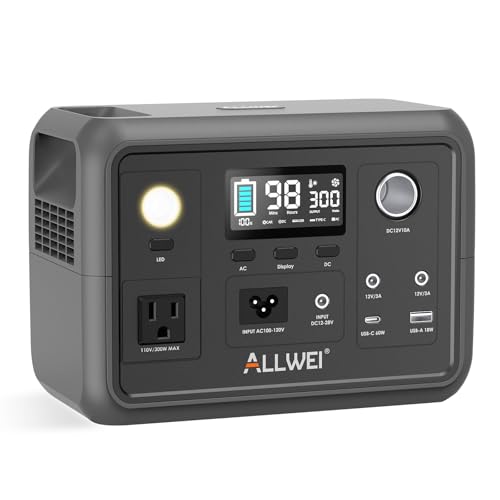
- 300W output with 256Wh capacity
- LiFePO4 battery rated for 3,000 cycles
- AC, car, USB-C, and solar charging support
Best For: Shoppers who want a lightweight, flexible backup power station
Compact Power With Fast Charging – Jackery Explorer 1000 v2
If you want a portable power station that stays easy to carry without giving up serious output, the Jackery Explorer 1000 v2 is a strong fit. It pairs 1,070Wh of capacity with 1,500W AC output, so it can handle everyday essentials and several small appliances while still remaining light enough for camping, road trips, and emergency use.
Best For: Campers, road-trippers, and homeowners who want a compact backup power station with fast recharging.
Pros:
- 1,500W AC output with 3,000W surge support for a wide range of devices
- Lightweight 23.8 lb build with a foldable handle for easier transport
- Fast charging via the Jackery App, with a 1-hour emergency charge mode
- LFP battery rated for over 4,000 cycles and long service life
Cons:
- 1-hour super charging requires enabling emergency charging in the app
- Solar charging is limited to Jackery solar panels only
Overall, this model stands out if portability and charging speed matter as much as output. It is a practical choice for portable power stations buyers who want a balanced mix of size, durability, and everyday versatility.
High-Output Home Backup Pick – BLUETTI AC180
The BLUETTI AC180 is a capable portable power station for users who need stronger output and more outlets in a single unit. With 1,152Wh of LiFePO4 capacity, 1,800W output, and 8 outlets, it is built to cover a broad mix of appliances while also serving as a rugged home backup source.
Best For: Users who want a higher-output portable power station for home backup, camping, or off-grid essentials.
Pros:
- 1,800W output and 8 outlets for handling multiple devices
- Charges fully in about 1 hour with 1,440W AC input
- Can be boosted to 2,700W through the BLUETTI App for higher-demand needs
- Supports solar charging and can provide emergency backup power in 20 ms
Cons:
- At 37.4 lb, it is heavier than some similarly sized models
- Full-speed charging depends on high AC input or added solar support
In practice, the AC180 is best for buyers who prioritize output, outlet count, and backup readiness over portability alone. It offers a useful middle ground between travel-friendly power and home-focused resilience.
Solar Charging Bundle Value – Jackery Explorer 1000 v2 + 200W Panel
This Jackery solar generator bundle is a good option if you want a portable power station package that includes solar capability right away. It combines the 1,070Wh Explorer 1000 v2 with a 200W solar panel, making it easier to start charging in the field for camping, road trips, or emergency backup.
Best For: Buyers who want a ready-to-use solar generator bundle with a portable power station and matching panel.
Pros:
- Includes both the Explorer 1000 v2 power station and a 200W solar panel
- 1,500W AC output and 3,000W surge capacity for common appliances
- Can reach 80% charge in about 6 hours with the 200W solar panel
- Lightweight 23.8 lb power station with the same versatile port mix as the base unit
Cons:
- Solar charging performance is slower than its fastest AC charging mode
- The Jackery app emergency charge mode is still required for the 1-hour fastest charge
For buyers building a solar-ready setup from day one, this bundle makes the decision easier. It is especially appealing if you want portable power stations support without separately sourcing a compatible panel.
Expandable Rapid-Charge Choice – EcoFlow Delta 3
The EcoFlow DELTA 3 is aimed at buyers who want fast charging, high outlet count, and room to grow. With 1,024Wh of capacity, 1,800W output, and support for up to 13 appliances at once, it is built as a flexible portable power station for emergency use, camping, and home backup.
Best For: Users who want a fast-charging power station with expansion options and strong multi-device support.
Pros:
- Reaches a full charge in 56 minutes with upgraded AC and solar input
- Expandable up to 5kWh with EcoFlow battery packs
- 1,800W output, 13 appliance support, and 3,600W surge with X-Boost
- LFP battery rated for 4,000 cycles to 80% capacity
Cons:
- Expansion requires compatible EcoFlow ecosystem battery packs
- Best performance depends on high-input charging methods
The DELTA 3 is a strong fit if you want speed now and expansion later. It brings a practical blend of quick turnaround, solid output, and long battery life for users comparing portable power stations with more basic backup units.
Ultra-Light Camping Pick – Jackery Explorer 300 Portable Power Station, 292Wh
For shoppers comparing portable power stations for light travel, the Jackery Explorer 300 is built around portability first. At 7.5 lbs with a 292Wh battery, it’s a practical grab-and-go option for camping, hiking, travel, and backup power for smaller devices.
Best For: Campers, hikers, and travelers who want a lightweight power station for laptops, cameras, drones, and CPAP use.
Pros:
- Very lightweight at 7.5 lbs, with an integrated handle for easy carrying.
- Offers 2 AC outlets, USB-C PD, 2 USB-A ports, and a 120W car port.
- LiFePO4 battery is rated for over 4,000 charge cycles.
- Supports solar charging, reaching 80% in about 2.8 hours with a 100W panel.
Cons:
- 300W rated output limits it to smaller appliances and devices.
- Solar panel is optional, so off-grid charging may require an added purchase.
This is a smart fit if you want a compact, durable power station that’s easy to pack and simple to use for everyday outdoor essentials. It trades raw wattage for portability and long-term battery life.
Fast-Charging Compact Pick – BLUETTI Elite 30 V2 Portable Power Station
The BLUETTI Elite 30 V2 stands out among portable power stations if you want compact size, fast recharging, and stronger output than many entry-level units. At 9.4 lbs with 288Wh capacity and 600W continuous power, it’s aimed at camping, road trips, home emergencies, and other situations where quick turnaround matters.
Best For: Buyers who need a lightweight power station with fast charging, UPS backup, and enough output for laptops, CPAP machines, and small appliances.
Pros:
- 600W continuous output with 1500W Power Lifting Mode for higher-demand devices.
- Charges quickly, with 0-80% in 45 minutes and 0-100% in 70 minutes.
- Includes 8 charging modes and supports solar, car, and wall charging.
- 10ms UPS switch helps keep critical devices running during outages.
Cons:
- 288Wh capacity is best for shorter runs and smaller loads.
- Heavier than the Jackery unit at 9.4 lbs, though still portable.
If fast wall charging and backup reliability are priorities, this model is one of the more practical compact options. It balances portability with stronger power delivery than many similarly sized units.
Mid-Size Household Backup Pick – Portable Power Station 500W, 519.48Wh
Among portable power stations, this 500W model is built more for broad device support and longer runtime than ultra-light carry convenience. With 519.48Wh of capacity, pure sine wave AC outlets, and up to 10 outputs, it’s designed for home backup, camping, and powering everyday essentials without fuel or fumes.
Best For: Users who want a mid-size solar generator for phones, laptops, routers, small appliances, and CPAP machines.
Pros:
- Large 519.48Wh capacity with 500W rated output for essential devices.
- Can power up to 10 devices at once, including AC, USB-A, USB-C, DC, car, and wireless charging.
- Pure sine wave AC output is better for sensitive electronics.
- Supports solar, wall, and car recharging options.
Cons:
- At 14.1 lbs, it is less convenient to carry than smaller portable power stations.
- Cannot run devices above 500W rated power.
- Solar panel is not included.
This is a sensible pick if you want a flexible all-around power station with more outlets and a bigger battery than compact travel models. It is especially useful when you need one unit to cover many small loads at once.
Compact Adventure Pick – Anker SOLIX C300 288Wh Solar Generator
If you want a small but capable portable power station for camping, travel, or backup use, the Anker SOLIX C300 keeps the focus on convenience. It offers 300W of continuous output, 288Wh of capacity, and a travel-friendly design that is 15% smaller than similar models, while still giving you enough ports for phones, laptops, cameras, drones, and other essentials.
Best For: Campers and travelers who want compact size, quiet operation, and flexible charging.
Pros:
- 300W output with 600W surge and 288Wh capacity for everyday essentials
- Eight charging options, including 3 AC outlets, dual 140W USB-C ports, car socket, and USB-A
- Fast recharge options, including 80% in about 50 minutes from a wall outlet
- Quiet 25dB operation and LiFePO4 battery rated for 3,000 cycles
Cons:
- Solar panel support is specific, so compatibility needs attention
- Shoulder strap is sold separately
Overall, this is a smart pick if portability matters as much as output. It balances practical power, modern USB-C charging, and long battery life in a compact shell that suits weekend trips and light emergency backup.
Versatile Backup Choice – ALLWEI 300W 256Wh LiFePO4 Power Station
The ALLWEI portable power station is built for users who want a straightforward, well-rounded option among portable power stations. With 256Wh of capacity, 300W continuous output, and a pure sine wave inverter, it can handle everyday gear like laptops, mini fridges, CPAP machines, and drones while staying compact enough for road trips and camping.
Best For: Buyers who want a lightweight backup unit with flexible charging and solid device support.
Pros:
- 256Wh capacity with 300W output and 600W peak surge
- LiFePO4 battery with 3,000 cycles and a 5-year warranty
- Six output ports, including AC, USB-C PD 60W, USB-A, DC, and car output
- Multiple recharge methods, including AC, car, solar, and dual charging
Cons:
- Only one AC outlet is listed
- Solar panel is sold separately
In practical terms, this model is a strong all-around choice if you want backup power without a bulky footprint. Its lightweight build, pass-through charging, and broad compatibility make it easy to use at home or on the road.
Budget Compact Pick – MARBERO 88Wh Portable Power Station
The MARBERO portable power station is a compact option for light-duty charging and emergency use. With 88Wh of capacity, an 120W surge rating, and a slim 3.2 lb design, it is easy to carry for camping, road trips, office use, or a quick backup during outages.
Best For: Travelers and casual users who need a small, easy-to-carry power source for basic devices.
Pros:
- Very compact at 6.5 x 4.6 x 3.1 inches and 3.2 lbs
- Eight output ports for phones, tablets, laptops, small appliances, and more
- Fast top-up to 80% in about 2 hours with the included adapter
- Built-in LED lights with brightness levels and SOS mode
Cons:
- 88Wh capacity is much smaller than larger portable power stations
- 80W listed wattage limits it to lighter devices
This is the kind of power station that makes sense when portability comes first. It is best viewed as a compact emergency charger and travel companion rather than a high-capacity solution for bigger appliances.
How We Picked These Portable Power Stations
We prioritized models that balance usable capacity, inverter output, battery type, charging options, and overall portability. For Portable Power Stations, the best choice is not always the biggest battery; it is the one that matches your devices, runtime needs, and how often you will carry it.
We also looked for practical features such as USB-C support, AC and DC output variety, solar compatibility, and battery chemistries like LiFePO4 for longer cycle life.
Quick Comparison: Which Size Fits Your Use Case?
Small models around 88Wh to 300Wh are best for phones, tablets, cameras, lights, and short trips. Mid-size units in the 500Wh to 1,000Wh range are a stronger fit for weekend camping, laptops, CPAP machines, and light emergency backup. Larger options above 1,000Wh are better for extended outages, higher-watt appliances, and users who want more breathing room.
Key Buying Factors for Portable Power Stations
Capacity and Runtime
Check watt-hours first, then estimate runtime based on the devices you plan to power. A larger battery usually means longer use, but it also adds weight and cost.
Output and Surge Power
Match the inverter wattage to your devices. Appliances with motors, compressors, or heating elements may need much more surge power than their running wattage suggests.
Battery Chemistry
LiFePO4 batteries generally offer better longevity and thermal stability than older lithium-ion designs, which can matter if you plan to use the unit often.
Charging Speed and Solar Support
Fast AC recharging is helpful for home backup, while solar input matters for off-grid travel. If you expect long trips, look for strong solar compatibility and efficient recharge times.
Portability and Build
Weight, handle design, and footprint matter more than many shoppers expect. A compact unit may be easier to live with than a heavier power station that offers more capacity than you truly need.
Who Should Buy Which Portable Power Stations?
If you need a compact charger for short outings or emergency phone backup, choose a smaller-capacity model. If you want dependable weekend power for camping or mobile work, a mid-size unit is usually the sweet spot. If you are preparing for outages or want to run more demanding electronics, step up to a high-capacity model with stronger output and LiFePO4 durability.
The best Portable Power Stations are the ones that fit your actual load, not just the biggest number on the box. Start with your devices, estimate runtime, and choose the smallest model that gives you comfortable headroom.