Choosing the right charge controller can make a big difference in how efficiently your solar setup performs and how long your batteries last.
Below, we’ve narrowed the field to the best solar charge controllers for 2026, with options for small cabins, RVs, boats, and larger off-grid systems.
Best 10 Solar Charge Controllers Picks for 2026
Smart Bluetooth MPPT

- Fast MPPT tracking for shaded or changing conditions
- VictronConnect app shows live data and history
- Intelligent load output adds low-voltage protection
Best For: Small 12/24V systems needing app monitoring and efficient MPPT charging
All-Weather MPPT Rover

- Up to 98% conversion and 99% tracking efficiency
- Works with Gel, AGM, Flooded, and Lithium batteries
- LCD plus app support via optional BT-2 module
Best For: Off-grid systems needing a rugged 40A MPPT controller
High-Output Bluetooth MPPT

- 50A output for larger charging loads
- VictronConnect app with live data and history
- Synchronizes with other SmartSolar controllers
Best For: Larger 12/24V systems needing high-current MPPT charging
Compact PWM RV Controller
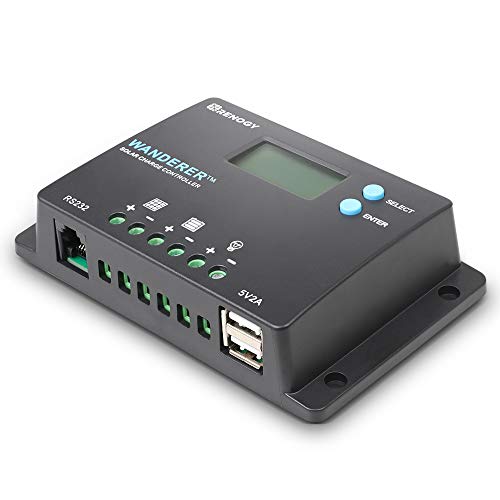
- 4-stage charging for multiple battery types
- Manual, automatic, and timed load control modes
- Compact IP32 design with ultra-low self-consumption
Best For: Small RV or marine systems needing a basic PWM controller
High-Power MPPT Pick
100A MPPT Solar Charge Controller with Auto Parameter LCD Display

- 100A MPPT controller with up to 99% efficiency
- 12V/24V auto-recognition simplifies installation
- LCD display and built-in safety protections
Best For: Large home or commercial solar systems needing high-capacity MPPT control
Efficient MPPT Classic
Victron Energy BlueSolar MPPT 75V 15A

- Fast MPPT tracking helps capture power in shade
- Supports AGM, Gel, LiFePO4, and flooded batteries
- Bluetooth monitoring works with an optional dongle
Best For: Smaller systems needing reliable MPPT charging and wide battery compatibility
Waterproof Thin PWM Choice
LNEX Solar Charge Controller 10A
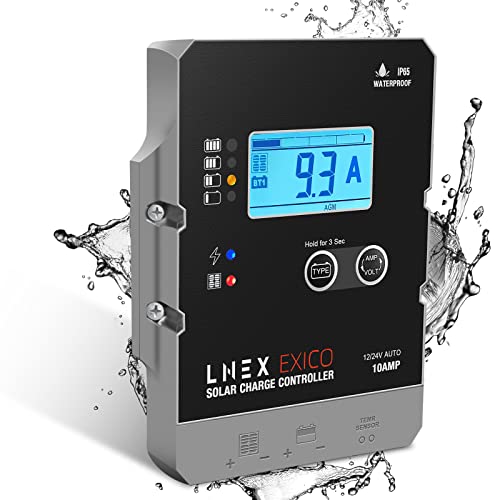
- IP65 waterproof body for outdoor use
- Thin design fits tight spaces
- LCD and LED indicators show charging status
Best For: Compact outdoor 12V/24V systems needing a waterproof PWM controller
High-Input MPPT Pick

- 150V max solar input for larger series strings
- Supports 12V/24V/36V/48V systems
- LCD display with optional Bluetooth monitoring
Best For: Larger off-grid or DIY systems needing high PV input headroom
Budget PWM Controller

- Automatic 12V/24V support
- Works with OPEN, AGM, and GEL lead-acid batteries
- Dual USB 5V/3A charging ports
Best For: Basic lead-acid solar setups needing simple controls and USB charging
High-Capacity MPPT Value Pick

- 100A controller with 12V/24V/36V/48V auto recognition
- Supports Seal, GEL, Flooded, and LiFePO4 batteries
- LCD with multiple modes and detailed system data
Best For: Higher-demand systems wanting a feature-rich controller with broad battery support
Smart Bluetooth MPPT – Victron SmartSolar 75V 15A
If you want solar charge controllers that focus on efficiency and visibility, this Victron SmartSolar MPPT is built for smart off-grid charging. It uses fast MPPT tracking to help extract strong output even when panels are partially shaded, and the VictronConnect app adds real-time monitoring plus 30-day performance history.
Best For: Small 12/24V solar setups where app-based monitoring and efficient MPPT charging matter most.
Pros:
- Fast MPPT tracking helps maximize available solar power, including in partial shade.
- VictronConnect app supports real-time data, performance history, settings, firmware updates, and alarms.
- Synchronizes with other SmartSolar MPPT controllers for system-wide charging coordination.
- Intelligent load output can disconnect loads automatically if battery voltage drops too low.
Cons:
- 15A output is better suited to smaller systems than high-current arrays.
- No dedicated display, so most monitoring depends on the app.
Overall, this is a compact, feature-rich controller for users who value data, flexibility, and optimized charging behavior. It fits best where a smaller current rating is enough and Bluetooth monitoring is a priority.
All-Weather MPPT Rover – Renogy Rover 40A 12/24V
Among solar charge controllers for off-grid use, the Renogy Rover 40A stands out for high conversion efficiency, broad battery support, and rugged weather tolerance. Its MPPT design is built to adapt quickly to changing light, while the LCD and app support make day-to-day setup and monitoring more practical.
Best For: Off-grid RV, cabin, and remote power systems that need a durable 40A MPPT controller with battery flexibility.
Pros:
- MPPT technology is rated for up to 98% conversion and 99% tracking efficiency.
- Supports Gel, AGM, Flooded, and Lithium batteries with 12V/24V auto-detection.
- Built-in protections include reverse polarity, overcharge, over-discharge, overload, short-circuit, and reverse current.
- Includes an LCD, remote temperature sensor, and DC Home app support via BT-2 (sold separately).
Cons:
- Bluetooth monitoring requires the BT-2 module sold separately.
- Larger and heavier than compact low-amp controllers.
This is a strong pick if you want a more capable controller for harsher environments and mixed battery types. The combination of protection, efficiency, and flexible charging profiles makes it a versatile off-grid option.
High-Output Bluetooth MPPT – Victron SmartSolar 100V 50A
If your solar charge controllers need to handle a larger array, this Victron SmartSolar MPPT offers a higher 50A output with the same connected monitoring approach. It is designed to maximize available power, synchronize with other controllers, and provide VictronConnect app access for system insight and setup.
Best For: Larger 12/24V solar systems that need a higher-current MPPT controller with Bluetooth monitoring.
Pros:
- 50A output suits larger charging loads than smaller controllers.
- Fast MPPT tracking helps maximize power, including when panels are partially shaded.
- VictronConnect app provides real-time data, 30-day history, configuration, firmware updates, and alarms.
- Can synchronize with other SmartSolar MPPT controllers for coordinated charging.
Cons:
- No display on the unit itself.
- Bulkier than compact lower-amp models.
For users scaling beyond small builds, this model brings more charging headroom without giving up the monitoring features Victron is known for. It is best when you want a higher-output controller and are comfortable relying on app-based visibility.
Compact PWM RV Controller – Renogy Wanderer 10A
For simpler solar charge controllers, the Renogy Wanderer 10A is a compact PWM option aimed at small RV and marine installations. It combines 4-stage charging, load control modes, and basic protection features in a lightweight design with an LCD for straightforward status checks.
Best For: Small 12/24V RV, marine, or backup setups that need an economical PWM controller with direct load control.
Pros:
- 4-stage charging supports AGM, Gel, Flooded, and Lithium batteries.
- Manual, automatic, and timed load control modes add flexibility for DC loads.
- Ultra-low self-consumption helps preserve battery power.
- Compact, IP32-rated design suits RV and marine electrical spaces.
Cons:
- PWM design is less advanced than MPPT controllers for maximizing panel output.
- 10A capacity limits it to smaller systems.
This is a practical choice when you want a simple, compact controller rather than a feature-heavy MPPT model. It works best in smaller systems where size, low draw, and direct load management are the main priorities.
High-Power MPPT Pick – 100A MPPT Solar Charge Controller with Auto Parameter LCD Display
If you want a solar charge controller built for larger setups, this 100A MPPT model focuses on easy setup and efficient charging. It offers 12V/24V auto-recognition, an LCD for real-time adjustments, and built-in protections that help keep battery charging stable and safe.
Best For: Home or commercial solar systems that need a high-capacity MPPT controller with simple LCD-based control.
Pros:
- 100A MPPT design with up to 99% efficiency for maximizing usable solar output
- 12V/24V auto-recognition helps simplify installation
- LCD display makes it easier to monitor performance and adjust settings
- Built-in protection against overcharging, short-circuits, and reverse polarity
Cons:
- Setup still requires connecting the battery first for auto-detection
- Bulkier, higher-capacity controller may be more than small systems need
Overall, this is a practical pick if your priority is capacity, visible controls, and efficient charging in one controller. It suits users who want a hands-off solar charge controller with straightforward monitoring and broad battery-tuning flexibility.
Efficient MPPT Classic – Victron Energy BlueSolar MPPT 75V 15A
This Victron Energy solar charge controller is aimed at efficient energy harvesting in smaller 12/24V systems. It uses multi-stage battery charging and fast MPPT tracking to capture power well even when panels are partially shaded, making it a strong option when consistency matters.
Best For: Smaller solar setups that need proven MPPT performance and support for multiple battery chemistries.
Pros:
- Fast MPPT tracking helps maximize power output, including in partial shade
- Multi-stage charging supports AGM, Gel, LiFePO4, and flooded lead-acid batteries
- Compact design with a 75V, 15A, 12/24V rating
- Bluetooth monitoring is available by adding a separate dongle
Cons:
- No built-in Bluetooth, so wireless control requires an extra accessory
- No display on the unit itself
- 15A output may be too limited for larger array sizes
For buyers who care more about charging quality than extra onboard features, this controller is a dependable, no-frills choice. It is a good fit when you want a solar charge controller with strong MPPT performance and broad battery compatibility.
Waterproof Thin PWM Choice – LNEX Solar Charge Controller 10A
For compact outdoor installs, this LNEX solar charge controller combines a thin profile with IP65 waterproofing and an LCD display. It uses smart PWM charging, auto-detects 12V or 24V systems, and adds multiple protection layers for everyday battery management.
Best For: Small 12V/24V solar setups that need a waterproof, low-profile controller with basic monitoring.
Pros:
- IP65 waterproof design suits outdoor exposure to spray, rain, or condensation
- Thin body makes it easier to fit into tight spaces
- 5-stage PWM charging includes soft start, bulk, absorption, float, and equalization
- LCD and LED indicators show current, voltage, and operating status
Cons:
- 10A output is best for smaller systems
- PWM design is less advanced than MPPT for power harvesting
- 90-day manufacturer warranty is shorter than many alternatives
This is a sensible pick if you want a simple controller that can handle outdoor conditions without taking up much space. It is best viewed as a practical, compact solar charge controller for modest battery-charging needs.
High-Input MPPT Pick – Renogy 60A Rover Lite 60A
If you’re comparing solar charge controllers for a larger DIY setup, the Renogy Rover Lite 60A is built around higher-input MPPT performance and broad battery compatibility. It supports 12V/24V/36V/48V systems, accepts up to 150V solar input, and is designed for reliable operation across demanding temperature ranges.
Best For: Larger off-grid or DIY systems that want a 60A MPPT controller with high PV input headroom.
Pros:
- 150V maximum solar input supports larger series strings and simpler wiring.
- Works with 12V, 24V, 36V, and 48V battery systems.
- Built for full-load performance from -31°F to 113°F.
- LCD display, labeled ports, and optional Bluetooth module support easier system monitoring.
Cons:
- Bluetooth monitoring requires a separate module.
- Compatible only with BT-2 Bluetooth module sold separately.
- Higher-capacity controller may be more than needed for small setups.
Overall, this is a strong fit if you need a dependable MPPT controller with plenty of input voltage room and flexible system matching. The included temperature sensor and 2-year warranty add practical value for long-term use.
Budget PWM Controller – 30A PWM with Dual USB
This 30A PWM solar charge controller is a practical option if you need a simple regulator for a basic 12V or 24V lead-acid setup. It includes an LCD display, automatic parameter memory, dual USB ports, and multiple protection features for everyday use.
Best For: Basic lead-acid solar systems that need an easy-to-use PWM controller with USB charging.
Pros:
- Automatically supports 12V or 24V systems.
- Compatible with lead-acid batteries such as OPEN, AGM, and GEL.
- Dual USB 5V/3A ports can charge small devices.
- Built-in protections include overcurrent, short circuit, reverse connection, and open circuit safeguards.
Cons:
- Not suitable for lithium batteries.
- PWM design is less advanced than MPPT controllers.
- Best suited to simpler setups rather than larger, high-efficiency arrays.
For small systems where ease of setup matters more than advanced tracking efficiency, this controller covers the essentials well. The LCD controls and safety protections make it straightforward to manage and monitor.
High-Capacity MPPT Value Pick – Upgraded 100A MPPT Controller
Among solar charge controllers, this 100A model stands out for users who want high current capacity, wide system support, and lots of display and control options. It automatically recognizes 12V/24V/36V/48V systems, supports several battery types, and adds dual USB charging plus multiple operating modes.
Best For: Higher-demand systems that want a feature-rich controller with 100A capacity and broad battery support.
Pros:
- 100A capacity with automatic 12V/24V/36V/48V system recognition.
- Compatible with Seal, GEL, Flooded, and LiFePO4 batteries.
- LCD shows working mode, voltages, currents, temperature, and delay time.
- Multiple modes, including timing control and light control options.
Cons:
- The product notes say it integrates MPPT and PWM technologies, so it may not provide full MPPT functionality.
- No included components are listed in the supplied details.
- Heavier and more feature-rich than a basic controller, which may be unnecessary for small systems.
This is a flexible choice if you want a high-capacity controller with detailed on-screen information and configurable operating modes. Its broad battery compatibility and protection features make it appealing for more involved solar installs.
How We Picked the Best Solar Charge Controllers
Our selection focused on practical performance, not just headline specs. We looked for Solar Charge Controllers with solid charging efficiency, clear battery support, useful monitoring features, and sensible sizing for common 12V, 24V, 36V, and 48V systems. We also favored models that make setup easier, whether through auto-detection, adjustable parameters, or readable LCD displays.
Quick Comparison
The main split is between PWM and MPPT. MPPT models are generally the better choice when you want higher efficiency, longer cable runs, or more output from variable sunlight. PWM models can still make sense for smaller, budget-friendly builds where the panel voltage closely matches the battery bank. Within Solar Charge Controllers, amperage matters just as much as charging type: undersizing can bottleneck performance, while oversizing can add cost without much benefit.
Key Buying Factors for Solar Charge Controllers
Controller Type
MPPT is typically best for maximizing harvest and supporting more flexible panel configurations. PWM is simpler and usually cheaper, but it’s less efficient in many real-world conditions.
System Voltage and Input Limits
Make sure the controller supports your battery bank voltage and that the solar input maximum is high enough for your panel string. This is especially important on larger arrays and higher-voltage panel setups.
Battery Compatibility
Check that the controller supports your battery chemistry, especially if you use lithium, gel, sealed lead-acid, or flooded batteries. Proper charging profiles help protect battery life and improve performance.
Current Rating
Choose a controller with enough amperage headroom for your solar array and future expansion. A little extra capacity is usually better than running at the edge of the limit.
Display and Controls
LCD screens, Bluetooth app support, and adjustable settings can make it easier to monitor charging, change battery modes, and troubleshoot system issues.
Who Should Buy Which Solar Charge Controllers?
If you’re building a compact setup for a van, RV, shed, or small battery bank, a 10A or 15A model may be enough. For mid-size off-grid systems, 30A to 40A controllers are often the sweet spot. Larger arrays, higher-voltage battery banks, or expansion-ready systems usually benefit from 50A, 60A, or 100A-class Solar Charge Controllers. For most buyers, the best choice comes down to matching controller type, battery chemistry, and real system size rather than simply choosing the highest amperage available.