If you are comparing a thermal monocular with built-in ranging, the RIX Titan-T3 stands out for putting several high-end functions in one handheld unit.
This RIX Titan-T3 thermal monocular review focuses on where that combination helps and where buyers should be cautious.
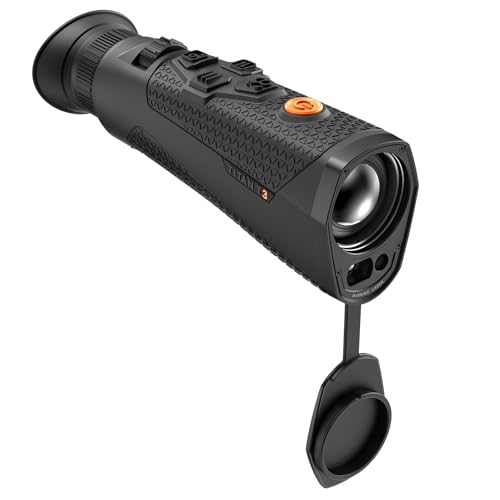
Titan T3 Review Summary
The RIX Titan-T3 makes sense for buyers who want a compact thermal spotting tool with rangefinding and a built-in ballistic calculator, not just a basic image viewer.
It is aimed at night hunters and field users who value distance awareness, a sharper display, and one-handed operation in a device that tries to do more than the average thermal monocular.
Best fit: users who want a feature-rich thermal monocular for spotting, ranging, and making faster field decisions.
Main tradeoff: the feature set is dense, so buyers who only need simple thermal viewing may be paying for capabilities they will not use.
Review Scorecard
| Category | Score | Why it scores this way |
|---|---|---|
| Thermal imaging utility | 9/10 | 384×288 resolution, 12 um detector, and a 25mm objective give it serious spotting-oriented capability. |
| Ranging and decision support | 9/10 | The integrated laser rangefinder and free ballistic calculation are the clearest differentiators in the listing. |
| Display and viewing clarity | 8/10 | The 1920×1080 OLED display is a strong spec for a handheld thermal monocular. |
| Low-light and contrast handling | 8/10 | The F0.9 lens and NETD under 20 mK point to a focus on usable image detail. |
| Handling and ergonomics | 8/10 | One-hand operation and near-eyepiece focus placement suggest practical field use. |
| Motion steadiness | 8/10 | Electronic image stabilization is valuable for walking, vehicle use, or shaky viewing. |
| Value for feature depth | 7/10 | The bundle of thermal, LRF, ballistic, stabilization, and zoom features is strong, but only useful if you need all of them. |
Key Features and Specifications of Titan T3
The Titan-T3 is a thermal imaging monocular built around a 25mm F0.9 objective lens and a 384×288 thermal sensor with a 12 um pixel pitch.
The listing also calls out a 1920×1080, 0.49-inch OLED display, NETD under 20 mK, and detection out to 1421 yards.
The biggest headline feature is the integrated laser rangefinder.
According to the listing, the Titan includes free ballistic calculation and can measure distances up to 1312 yards.
That makes it more than a simple thermal viewer: it is meant to help the user turn a visual contact into a usable distance estimate and a more informed next step.
Other supported features include:
- One-hand operation with controls arranged for easier reach
- Electronic image stabilization to reduce shake and blur
- RET technology that uses AI-assisted pixel detail enhancement during digital zoom
- A 25mm F0.9 lens described as gathering more light than F1.0 optics
- A compact monocular format aimed at field use rather than tripod-only viewing
For buyers comparing specs, the Titan-T3 is less about raw simplicity and more about stacking practical tools into a single handheld optic.
Pros and Cons of Titan T3
Pros
- Integrated rangefinding removes the need to pair a separate device for distance awareness.
- Ballistic calculation adds practical value for hunters who want more than a thermal image.
- High-resolution OLED display should help the viewed image feel more detailed than lower-resolution screens.
- F0.9 lens is a strong listing point for low-light image gathering.
- Image stabilization is useful when your hands are moving or the environment is not steady.
- One-hand controls suggest the device is built for actual field use, not just bench viewing.
Cons
- Feature density can be overkill if you only want a basic thermal spotter.
- The listing is ambitious on specs, which means buyers should care about how those features fit their actual use case.
- Digital zoom is still digital zoom, even with RET processing, so expectations should stay realistic.
- No battery, weight, or enclosure details are provided in the supplied evidence, which makes long-session planning harder from the listing alone.
The short version of the RIX Titan-T3 pros and cons is straightforward: it offers a lot of useful field functions, but the value depends on whether you will use the full package.
Who Should Buy Titan T3?
The Titan-T3 is a strong match for night hunters, landowners, and field observers who want thermal detection plus distance context in the same tool.
It is also a sensible choice for users who prefer a handheld monocular that can be operated one-handed and used while moving.
It should also appeal to buyers who want a clearer display and who care about stabilization when scanning, walking, or viewing from a vehicle.
The integrated rangefinder and ballistic calculator make the most sense for users who need faster decision support, not just a heat signature.
Who should skip it?
Anyone who wants the cheapest possible thermal entry point, or anyone who does not need ranging and ballistic help.
If your use case is occasional thermal checking and nothing more, the Titan-T3 may be more feature-rich than necessary.
Thermal Capability and Field Use
Detection and Detail
The 384×288 sensor, 12 um pixel pitch, and stated detection range up to 1421 yards point to a tool designed for serious spotting rather than casual novelty use.
The real-world meaning is not “identify everything at long distance,” but rather “give the user enough thermal information to work with at range.”
Ranging Workflow
The built-in laser rangefinder up to 1312 yards is one of the most practical parts of the package.
It reduces the amount of gear juggling and makes the Titan-T3 more useful when distance matters immediately, especially in a hunting context.
Display and Viewing Comfort
The 1920×1080 OLED display should help the viewing experience feel more refined than lower-resolution alternatives.
For a thermal monocular, that matters because the sensor is only part of the experience; the screen is where detail and usability become visible to the user.
Stability and Zoom
Electronic image stabilization is a meaningful feature for handheld use because thermal devices are often used while walking, scanning, or riding in a moving vehicle.
RET zoom enhancement is also relevant, but it should be viewed as a detail-preserving aid rather than a replacement for native optical clarity.
Alternatives to Titan T3
If you want a comparable Amazon search starting point, look at the AGM thermal monocular, Pulsar thermal monocular, ATN thermal monocular, and Guide thermal monocular lines.
Those brands are common comparison points for buyers who want to weigh detection, display quality, and feature depth.
If your priority is a built-in rangefinder specifically, it is worth searching for thermal monocular LRF options rather than standard thermal spotters.
That comparison will quickly show whether the Titan-T3’s rangefinding and ballistic features justify its complexity for your use case.
Is Titan T3 Worth It?
The RIX Titan-T3 is worth considering if you want a thermal monocular that goes beyond basic imaging and gives you ranging, ballistic calculation, stabilization, and a high-resolution display in one unit.
It is a better fit for serious field use than for casual thermal curiosity.
If those extra capabilities match how you actually work, the Titan-T3 looks like a practical and well-specified option.
If you do not need the rangefinder or ballistic support, a simpler thermal monocular will likely be the better buy.