The right paddleboard pump can turn a tiring pre-launch chore into a quick, predictable part of your setup. The best models combine automatic shutoff, useful pressure control, and enough power to inflate one or more boards efficiently.
We compared 10 electric SUP pumps across battery design, inflation speed, pressure range, portability, and deflation features to help you choose the best fit for weekend outings, travel, or frequent use.
Best 10 Paddleboard Pumps Picks for 2026
High-Capacity Pick
50PSI Rechargeable Paddle Board Pump

- 12000mAh battery supports up to four boards at 12 PSI
- Three-stage inflation reaches 420 L/min
- Cooling system, auto shutoff, deflation, and 12V support
Best For: Group outings and extended battery use
Fast-Charging Choice

- Inflates a 10.6-foot board to 15 PSI in about five minutes
- 96.2Wh battery supports up to five boards at 15 PSI
- Dual LED display, auto shutoff, seven nozzles, and 30W charging
Best For: Fast setup for individuals or groups
Lightweight Value
Hydrohero 20PSI Rechargeable SUP Pump

- Inflates a 10.5-foot SUP to 12 PSI in five minutes
- Light 2.5-pound body with handle and waterproof bag
- Dual-stage airflow, auto shutoff, deflation, and seven nozzles
Best For: Solo paddlers seeking a lighter pump
Quickest Inflation
OutdoorMaster Shark 3 SUP Pump

- Inflates a 10.6-foot board to 15 PSI in 3:50
- One charge supports four boards at 15 PSI
- Type-C and 12V/15.8V inputs plus eight nozzles
Best For: Fast setup with flexible charging
Best Value 12V Pick
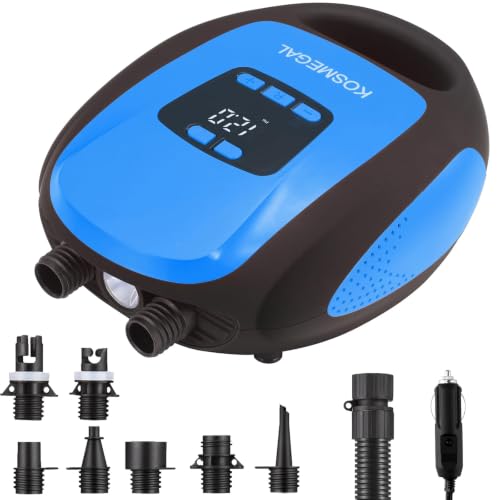
- Automatic pressure shutoff with four selectable units
- Six nozzles and a carry bag included
- 12V car-powered; not rechargeable
Best For: Car-based paddleboard trips and general inflatables
Best Rechargeable Option

- 15,600mAh battery supports multiple SUP inflations
- Dual-stage airflow and automatic shutoff
- Includes 12V car power and two-year warranty
Best For: Cordless group outings and repeated inflations
Best Multi-Mode Choice

- SUP, tire, and deflation modes
- Eight adapters and a 10-foot power cable
- 50 PSI capacity with automatic shutoff
Best For: Vehicle-based outdoor trips needing tire and SUP inflation
Best Cordless Pick

- Inflates 3–4 boards per charge
- Dual-stage inflation with auto shutoff
- Includes 12V backup and deflation mode
Best For: Portable beach trips, camping, and group outings
Most Versatile
50PSI Rechargeable Paddleboard Pump

- 10,000mAh battery inflates up to four boards
- SUP, tire, and deflation modes
- Includes 12V backup, seven adapters, and LED light
Best For: Multi-purpose outdoor and roadside use
Best Car-Powered Option

- Direct 12V power with no battery to recharge
- Dual-stage inflation up to 20 PSI
- Includes seven nozzles and 3-meter cable
Best For: Vehicle-based paddlers and repeated trip use
High-Capacity Pick – 50PSI Rechargeable Paddle Board Pump
For shoppers comparing paddleboard pumps, this rechargeable electric model stands out for its large battery, three-stage inflation, and built-in cooling. It reaches 12 PSI in 8.5 minutes or less, includes automatic shutoff and deflation, and can also handle car tires, boats, and kayaks.
Best For: Group outings and paddlers who want extended battery life with a portable design.
Pros:
- 12000mAh battery can inflate and deflate up to four paddleboards at 12 PSI per charge.
- Three-stage airflow reaches 420 liters per minute and supports fast inflation.
- Active cooling, automatic shutoff, LED display, built-in light, carrying bag, and 12V vehicle support add convenience.
Cons:
- Its maximum-pressure rating is much higher than most SUP applications, so users should still set the correct target pressure.
- At 2.9 pounds, it is portable but not the lightest option in this roundup.
Choose this pump if battery capacity and repeated use matter more than minimizing size. Its cooling system and vehicle-power option make it particularly practical for multi-board sessions.
Fast-Charging Choice – CYCPLUS 20PSI SUP Pump
The CYCPLUS is one of the more speed-focused paddleboard pumps in this lineup. Its dual-stage system can inflate a 10.6-foot board from 0 to 15 PSI in about five minutes, while the 96.2Wh battery supports up to five similar boards at 15 PSI.
Best For: Paddlers and teams who prioritize fast inflation and high battery endurance.
Pros:
- Dual-stage airflow delivers up to 430 liters per minute and switches to a 120 L/min high-pressure stage.
- 96.2Wh battery can inflate five 10.6-foot boards to 15 PSI on a charge.
- Auto shutoff, dual LED pressure displays, seven nozzles, and 30W fast charging are included.
Cons:
- At 3.6 pounds, it is heavier than several competing rechargeable models.
- Its 20 PSI maximum pressure may be more than needed for typical SUP inflation.
This is a strong fit when several boards need to be prepared without frequent recharging. The high-capacity battery and accurate pressure monitoring make it especially useful for group beach days.
Lightweight Value – Hydrohero 20PSI Rechargeable SUP Pump
If portability is a priority, the Hydrohero is among the lighter paddleboard pumps here. It can inflate a 10.5-foot SUP to 12 PSI in five minutes, provides automatic shutoff and deflation, and includes seven nozzles for other inflatables.
Best For: Solo paddlers who want a compact pump with quick inflation and straightforward controls.
Pros:
- Weighs about 2.5 pounds and includes a built-in handle and waterproof storage bag.
- Dual-stage operation provides 400 L/min for speed and 100 L/min for pressure.
- Type-C QC3.0 30W charging, LED pressure display, auto shutoff, and deflation add usability.
Cons:
- The 38.48Wh battery inflates three 10.5-foot boards to 12 PSI, fewer than some higher-capacity options.
- The charging plug is not included.
The Hydrohero balances speed, weight, and useful accessories well. It makes sense for users who usually inflate one to three boards and prefer carrying less gear to the launch point.
Quickest Inflation – OutdoorMaster Shark 3 SUP Pump
The OutdoorMaster Shark 3 is built for rapid setup, making it a compelling choice among paddleboard pumps. It inflates a 10.6-foot board to 15 PSI in 3 minutes 50 seconds, deflates it in 1 minute 20 seconds, and can service four boards per charge.
Best For: Time-conscious paddlers who want fast performance and flexible charging options.
Pros:
- 74Wh battery supports inflation and deflation for four 10.6-foot boards at 15 PSI.
- Type-C and 12V/15.8V DC inputs provide home and vehicle charging flexibility.
- 20 PSI maximum pressure, auto shutoff, digital display, cooling system, and eight nozzles improve versatility.
Cons:
- The manufacturer notes noise of up to 88dB during high-pressure inflation.
- At 3.64kg, it is substantially heavier than the lightest pump in this selection.
- Its warranty is one year, shorter than some alternatives listed here.
The Shark 3 is a practical pick when minimizing setup time is the main goal. Its dual-input charging and broad nozzle selection add flexibility, but users should be comfortable with its heavier body and louder high-pressure operation.
Best Value 12V Pick – KOSMEGAL 20 PSI SUP Pump
If you need practical paddleboard pumps for occasional launches, the KOSMEGAL is a compact 12V option designed for use from a running car. It supports preset pressure settings, automatic shutoff during inflation, and multiple nozzle types for inflatables beyond paddleboards.
Best For: Car-based paddleboard trips where a compact, budget-conscious pump is more useful than a rechargeable battery.
Pros:
- Automatic shutoff at the selected pressure, with PSI, KPa, BAR, and KG/CM² settings.
- Includes six nozzles for SUPs, kayaks, air mattresses, tents, and other inflatables.
- Backlit LCD display, integrated flashlight, and included carry bag.
Cons:
- It is not rechargeable and must connect to a 12V car socket while the car is running.
- The supplied recommendation lists 10 PSI for SUP use, with 15 PSI as the maximum recommended pressure.
- Deflation requires manual shutoff.
The KOSMEGAL makes sense when your launch site is accessible by car and you value simple controls and broad nozzle compatibility. Its corded design is the main limitation for remote use.
Best Rechargeable Option – 50 PSI Cordless SUP Pump
Among these paddleboard pumps, this rechargeable model stands out for portable, repeated use away from a constant power outlet. Its 15,600mAh battery, dual-stage inflation, active cooling, and automatic shutoff are suited to group outings and multiple inflatables.
Best For: Paddlers who want cordless convenience and enough battery capacity to inflate several boards on one charge.
Pros:
- 15,600mAh battery can inflate a 10.6-foot SUP up to five times at 12 PSI or four times at 15 PSI.
- Dual-stage airflow combines 420 L/min for filling with 100 L/min for high-pressure inflation.
- Supports inflation and deflation, auto-off, a real-time LED display, and a 12V car connector.
- Compact 3-pound design includes a nylon handle, storage bag, and two-year warranty.
Cons:
- Charging is required before cordless use, even though a 12V car connection is also available.
- At 50 PSI maximum, its broader tire capability may be more than some SUP-only users need.
This is the most versatile choice for users who dislike running a cord from a vehicle. The battery capacity and cooling system support repeated inflation, while the dual-stage design helps balance speed and pressure accuracy.
Best Multi-Mode Choice – 50 PSI 12V SUP Pump
This 12V model is one of the more versatile paddleboard pumps for users who also want to inflate car tires and other outdoor gear. Dedicated SUP, car-tire, and deflation modes simplify setup, while the long power cable and eight adapters improve reach and compatibility.
Best For: Drivers and outdoor enthusiasts seeking one corded pump for paddleboards, tires, kayaks, and assorted inflatables.
Pros:
- 50 PSI capacity can inflate a 10.6-foot SUP to 12 PSI in about six minutes and a car tire to 36 PSI in about 2.5 minutes.
- Dedicated SUP, car-tire, and deflation modes with adjustable target pressure and auto-off.
- Includes an 8-adapter set, dedicated tire hose, and 10-foot power cable.
- Large LED display and built-in white, SOS, and flashing red lights support low-light use.
Cons:
- It is corded and depends on a 12V car cigarette-lighter socket.
- The supplied warranty is one year.
The B0GXVN3W66 is a strong all-around pick if tire inflation is as important as paddleboard setup. Its accessories and distinct operating modes add convenience, but the car-powered design limits use away from a vehicle.
Best Cordless Pick – Rechargeable SUP Pump
For shoppers comparing paddleboard pumps, this rechargeable model is a practical choice when you want cordless operation and enough capacity for group outings. Its dual-stage inflation, preset pressure shutoff, digital display, and deflation mode cover the main setup and packing tasks.
Best For: Beach trips, camping, and paddlers who need a portable pump for several boards.
Pros:
- 13,500mAh battery is rated to inflate 3–4 paddleboards per charge.
- Inflates a 10.6-foot SUP to 12 PSI in about 7 minutes and 15 PSI in about 9 minutes.
- Includes automatic shutoff, real-time digital pressure monitoring, and fast deflation.
- Works with SUPs, kayaks, rafts, tents, and other inflatables, with 12V car backup power.
Cons:
- Requires about 4–5 hours for a full recharge.
- At 2.86 pounds, it is portable but not the lightest option.
- The battery should be fully charged before extended storage and use.
This is a well-rounded cordless paddleboard pump for users who prioritize portability and multi-board capacity. The included car connector adds flexibility if the battery runs low, while the display and auto-off function make pressure control straightforward.
Most Versatile – 50PSI Rechargeable Paddleboard Pump
This paddleboard pump stands out for its combination of cordless power, high pressure, and multiple operating modes. It offers SUP, tire, and deflation settings, plus a digital display and emergency light for added usefulness around the car or campsite.
Best For: Outdoor users who want one rechargeable pump for boards, kayaks, inflatables, and vehicle tires.
Pros:
- 10,000mAh battery is rated for up to four paddleboards per charge.
- Inflates a 10.6-foot board to 12 PSI in about 6 minutes and 15 PSI in about 8 minutes.
- Supports inflation, deflation, and tire modes with real-time pressure monitoring and auto-off.
- Offers 12V DC backup power, Type-C charging, seven adapters, and an emergency LED light.
Cons:
- The supplied notes do not specify the pump’s weight or physical dimensions.
- The claimed 50 PSI maximum is more pressure capacity than most paddleboards require.
- Full charging still takes approximately 3.5–4.5 hours.
Choose this model if versatility matters as much as SUP inflation. Its tire mode and emergency light broaden its usefulness beyond the water, while the rechargeable battery and 12V connection provide two ways to keep operating.
Best Car-Powered Option – 12V SUP Pump
Among paddleboard pumps, this model is designed for paddlers who prefer dependable vehicle power over battery charging. It plugs into a 12V car socket, uses dual-stage inflation for boards up to 20 PSI, and automatically stops at the selected pressure.
Best For: Car-based paddlers who want repeatable inflation without managing a built-in battery.
Pros:
- Dual-stage system combines 360L/min fast fill with 100L/min high-pressure inflation.
- Inflates an 11-foot SUP to 12 PSI in about 6 minutes.
- LED display supports PSI/BAR switching and pressure accuracy up to ±0.1 PSI.
- Includes a 3-meter cable, seven nozzles, storage bag, and deflation capability.
Cons:
- It has no built-in battery and must remain connected to a 12V car socket.
- Its usefulness is limited when a suitable vehicle outlet is unavailable.
- The supplied warranty is one year.
This is the straightforward choice for users who inflate beside their vehicle and do not want to monitor battery capacity. The long cable, broad nozzle selection, cooling design, and stated 500-plus-cycle testing support repeated use on paddling trips.
How We Picked These Paddleboard Pumps
We focused on practical features that affect real-world SUP setup rather than headline pressure ratings alone. Each selected pump offers electric inflation and is designed for paddleboards or similar high-pressure inflatables. We compared battery capacity, power options, automatic shutoff, dual-stage inflation, deflation support, included adapters, and portability.
Because product specifications can vary by model and seller, confirm the listed PSI, battery capacity, charging method, hose connections, and included accessories before ordering. A pump that matches your board’s valve and recommended pressure is more important than the highest advertised number.
Quick Comparison
| Feature | Why It Matters |
|---|---|
| Maximum pressure | Determines whether the pump can reach your board’s recommended PSI. |
| Battery or 12V power | Controls where and how conveniently you can inflate. |
| Dual-stage inflation | Uses faster airflow initially, then higher pressure for final inflation. |
| Automatic shutoff | Stops the pump at the selected pressure and reduces overinflation risk. |
| Deflation mode | Makes packing and storage easier by removing air from the board. |
Key Buying Factors for Paddleboard Pumps
Pressure and Compatibility
Most inflatable paddleboards require a high-pressure pump capable of reaching roughly 12 to 20 PSI, but the exact requirement varies. Choose a model that comfortably exceeds your board’s recommended pressure and includes a compatible valve adapter. Extremely high maximum PSI is not automatically better if the pump is slower, heavier, or less convenient.
Battery Capacity and Power Source
Rechargeable pumps are convenient for beaches, campsites, and remote launches. Larger batteries may support multiple boards, but they usually add weight and charging time. A 12V car-powered pump can be a better choice for reliable extended use near a vehicle, while some buyers may prefer a pump offering both rechargeable and vehicle power.
Speed, Noise, and Controls
Dual-stage designs typically inflate quickly at low pressure before switching to a slower high-pressure stage. Look for a clear digital display, simple pressure controls, an automatic shutoff function, and a hose that stays securely attached. Electric pumps are usually loud, so a shorter inflation time can matter as much as the published airflow rating.
Portability and Accessories
Consider the pump’s size, handle, storage case, charging cable, hose length, and adapter selection. Deflation is especially useful when packing a board tightly into its carry bag. Extra nozzles can help with other inflatables, but they should not outweigh dependable SUP valve compatibility.
Who Should Buy Which Paddleboard Pumps?
- Choose a rechargeable pump if you launch away from your car or want a simple cordless setup.
- Choose a 12V car-powered model if you inflate several boards or prioritize uninterrupted power.
- Choose a high-capacity battery pump for group outings, frequent paddling, or multiple inflation cycles.
- Choose a compact pump if storage space and carrying weight matter most.
- Choose a model with deflation if you want faster pack-down and easier board storage.