GOYOJO GRS225RF thermal riflescope review for buyers who want thermal detection, rangefinding support, and rugged field use in one optic.
If you are comparing a thermal scope for hunting or brush-heavy night work, this model is built around those needs.
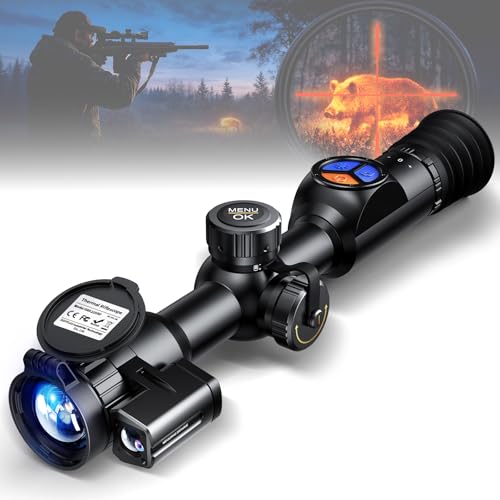
GRS225RF Review Summary
The GOYOJO GRS225RF is a feature-dense thermal riflescope aimed at hunters who want more than basic heat detection.
Its value comes from combining a 256×192 thermal sensor, 50Hz imaging, rangefinding and ballistic assistance, recording, and a durable housing in a single platform.
That mix makes sense for hunters working coyotes, hogs, or other targets in low-visibility terrain where quick ranging and shot planning matter.
It is less about minimalist simplicity and more about putting the core tools in one optic so you can scan, identify, range, record, and adapt without stacking separate gear.
Review Scorecard
| Category | Score | Why it earns that score |
|---|---|---|
| Thermal capability | 8/10 | 256×192 sensor, <35mK sensitivity, and 25mm lens are solid for the class. |
| Motion handling | 8/10 | 50Hz refresh should help the image stay smoother on moving animals. |
| Shot planning | 9/10 | Rangefinding and ballistic assistance are the main practical differentiators. |
| Feature set | 9/10 | Recording, app sharing, 10 reticles, 7 color modes, and zoom give it breadth. |
| Field durability | 8/10 | IP67 protection and recoil tolerance up to 800g/0.4 ms suggest serious build intent. |
| Ease of use | 7/10 | Plenty of capability is useful, but more features usually means a steeper learning curve. |
| Buyer value | 8/10 | Strong for hunters who will use the extras, less compelling if you only need basic thermal view. |
Key Features and Specifications of GRS225RF
The GOYOJO GRS225RF is built around a 256×192 thermal sensor with a 25mm objective lens and a high-resolution 1440×1080 OLED display.
The listing also calls out <35mK sensitivity, which matters because it supports finer temperature contrast and can help separate animals from background clutter in challenging conditions.
Several details point to a scope meant for practical field use rather than a bare-bones thermal tube.
The image refresh rate is 50Hz, the optical zoom is listed as 1x to 8x adjustable, and the unit includes 7 selectable imaging modes plus 10 reticle options.
For hunters moving between brush, open lanes, and changing target distance, that flexibility is a real advantage.
The most distinctive feature is the inclusion of rangefinding and ballistic assistance.
According to the listing, the scope can calculate holdover to help with more confident shots on coyotes at distance or hogs in thick cover.
That is the sort of support that turns a thermal optic from a viewing tool into a decision-making tool.
Other listed capabilities add to that package:
- RAV smart recording that captures when a shot is fired.
- 32GB internal storage for saved footage.
- Mobile app streaming for real-time viewing and sharing nearby.
- IP67 waterproof rating for harsh conditions.
- Recoil resistance up to 800g/0.4 ms.
- 7 to 9 hours of runtime depending on conditions.
- Operating temperature range from -22°F to 122°F.
The description also mentions a 7.0° x 5.3° field of view and 65mm eye relief.
Those are useful details because they suggest a scope designed to stay usable over time while giving a workable view for scanning and tracking.
For buyers comparing specs, the cleanest way to think about this model is simple: it is not just a thermal sight, it is a multi-function hunting optic with rangefinding, recording, streaming, and ruggedization built in.
Pros and Cons of GRS225RF
Pros
- Rangefinding and ballistic assistance are genuinely useful for real hunting decisions, not just marketing.
- 50Hz thermal imaging should deliver smoother motion tracking than slower-refresh options.
- 256×192 resolution with <35mK sensitivity is a credible core thermal package.
- RAV recording and 32GB storage add training and review value.
- IP67 protection and strong recoil tolerance support rough field conditions.
- Multiple modes, reticles, and zoom levels make it adaptable across scenarios.
Cons
- The feature set is broad enough that setup and menu learning may take time.
- A 256×192 sensor is useful, but buyers wanting maximum thermal detail may want to compare higher-resolution options.
- The scope is aimed at hunters who will actually use the advanced functions; simpler users may not need all the complexity.
- The listing emphasizes capability more than simplicity, so this is not the best fit if you want a no-frills thermal sight.
Who Should Buy GRS225RF?
Buy the GOYOJO GRS225RF if you want one thermal scope that covers detection, ranging, shot planning, and recording.
It fits hunters who move through brush, nighttime terrain, or other low-visibility environments where knowing what you are seeing is only part of the problem.
The added ballistic help makes it more appealing for users who want to make faster, more confident decisions after identifying a target.
It also makes sense for buyers who value field durability.
The IP67 rating, recoil resistance, and temperature range suggest a product designed for hard use rather than casual range novelty.
If you expect to carry it through demanding conditions, that matters more than a flashy spec sheet.
Skip it if your use case is simple or occasional.
If you only need basic thermal viewing, or if you prefer a lighter learning curve with fewer modes and menus, the GRS225RF may be more scope than you need.
It is also not the obvious pick for buyers whose top priority is the highest available image resolution rather than a balanced feature set.
Thermal Performance and Hunting Use
Detection and Contrast
The combination of a 25mm lens, 256×192 sensor, and <35mK sensitivity is the core of this optic.
That is the part that should matter most to buyers because it defines how much thermal information the scope can gather before software features even enter the picture.
Movement and Tracking
The 50Hz refresh rate is important because hunters do not scan static scenes all night.
Smooth motion can make it easier to keep up with moving targets, especially when the landscape is cluttered or the animal is only visible for short windows.
Ranging and Holdover
Rangefinding and ballistic assistance are the most decision-relevant features here.
The scope is clearly aimed at making distance estimation and holdover less guesswork-driven, which is valuable when shots have to happen quickly and conditions are not ideal.
Recording and Review
RAV recording with 32GB internal storage adds useful accountability and training value.
It is not just about keeping a clip; it also helps you review shot timing, target movement, and how the optic performed in the moment.
Alternatives to GRS225RF
If you want a broader field of comparison, look at other thermal riflescope lines that often appear on Amazon:
- AGM thermal riflescope search
- Pulsar thermal riflescope search
- ATN thermal riflescope search
- Thermal monocular search
AGM and Pulsar are worth checking if you want to compare feature depth, display behavior, and hunting-specific imaging ecosystems.
ATN is a common comparison point for buyers who want integrated digital features.
A thermal monocular is the better alternative if you want handheld scanning first and rifle mounting second.
Is GRS225RF Worth It?
The GOYOJO GRS225RF is worth it for buyers who will use its advanced hunting tools.
The thermal core is credible, the refresh rate is practical, and the rangefinding, ballistic assistance, recording, and rugged construction make it more versatile than a basic thermal scope.
If you want a single optic that supports real field decisions, this is a strong candidate.
If you want the simplest possible thermal setup, or you are mainly shopping for maximum image resolution, keep comparing before you buy.